


SONG LYRICS AS LITERATURE
Filed under: WRR@LARGE — Tags: Adele, Baby Can Dance, Bob Dylan, Bono, Carsie Blanton, Gerri George, Jess Righthand, Jonathan Takiff, Lady Gaga, New Orleans, Paul Simon, Song Lyrics as Literature, The Washington Post, Usher, Wild River Review, Woody Guthrie — joystocke @ 4:32 pm
SONG LYRICS AS LITERATURE
Posted by Gerri George
Lyrics are flash stories; they are poems, they contain elements of memoir; in some cases, they address personal themes, at times universal. Lyrics reflect the individual journey or cultural observations of the songwriter. They are a serious art form.
But are they literature?
Although there are many definitions of literature, my bookshelf copy of Webster’s New World Dictionary offers the following:
Literature: all writings of prose or verse, especially those of an imaginative or critical character…. excellence of form, great emotional effect….writings of a particular time, country, region….all the compositions for a specific musical instrument, voice, or ensemble.
Lyric: a lyric poem; the words of a song, as distinguished from the music.
The definition of a lyric is simple; applying the definition of literature to song lyrics is not. The above is a broad definition of literature, vis-à-vis lyrics, to be sure, but I’d rather fold lyrics into the literary family, than exclude them.
Like literature in general, song lyrics often reflect the times in which they were written: While the song Yankee Doodle Dandy seems nothing more than a cheerful patriotic ditty of words and music, in reality, it was hugely political. The website Archiving Early America explains that the song, first a nursery rhyme ridiculing England’s Oliver Cromwell as ”Nankee Doodle,” evolved into “Yankee Doodle” (indicated a trifling fellow), and “Dandy” (affected manners and dress). The British made fun of the American colonial motley crew, the early version who wore furs and buckskins, but over time, the motleys got their revenge, singing Yankee Doodle Dandy when the British surrendered. Great emotional effect? Writings of a particular time, country, or region? All the compositions for a specific musical instrument, voice, or ensemble? The lyrics can certainly be classified as literature. Who knew?
No one would argue the significance of Woody Guthrie’s lyrics. The insight helps to make his work shine as literature.
From Ed Cray’s book, Ramblin Man: Woody Guthrie on songwriting, “I am out to sing the songs that make you take pride in yourself and in your work. He considered himself The Dustiest of the Dust Bowlers. His lyrics in the classic “This Land Is Your Land,” are writings of a particular time, country and region, and offer great emotional effect. He labeled his guitar “This Machine Kills Fascists” which acknowledges the premise and passion of his lyrics. No slouch himself, of course, Bob Dylan, in Chronicles, Volume One, said Woody Guthrie’s songs “…had the infinite sweep of humanity in them.”
Sherrie A. Inness in her book Disco Divas: Women and Popular Culture in the 1970’s, says sexual openness was still going strong, but lyrics were becoming more self-reflective, a manifestation of the times. Singer-songwriters were trained in the style in which lyrics mattered. Carole King, “So Far Away,” and Carly Simon dealt with honesty, past lovers, and separations, themes not uncommon to literature.
Robert Hazard’s lyrics in “Girls Just Want to Have Fun” were timely and historic. The song continues its huge popularity with many uses worldwide, and has been covered by at least 30 artists.
Popular Philadelphia-based singer-songwriter Carsie Blanton, who tours nationwide, creates lyrics that are catchy, yet smart; they’re accessible (just ask her avid fans). Metaphors, similes. Her lyrics can also be fun – not unlike Paul Simon’s approach to “Fifty Ways to Leave Your Lover.”
In her Baby Can Dance, (see video filmed in New Orleans) her lyrics reflect a view that it doesn’t matter how you dress or look, as long as you can dance; talent wins out. The title track on Idiot Heart, Carsie’s new CD: He was a dark-eyed man and I knew right away, It was gonna take a turn for the worst, So I said “Hey, heart, if you’re gonna go crazy Give a little warning first” Idiot heart I shoulda left you at home You gimme nothin but hard love bad luck When you gonna leave me alone? Click here: Baby Can Dance
In the title track from Buoy, her previous CD, she offers a tour-de-force of similes:
he showed up
brighter than a buoy
slicker than a submarine
bonnie as a berry
cuter than a kidney bean
she was struck
dumber than a detour
quicker than a pistol shot
revving like a motor
hotter than a parking lot
Carsie’s songs are transferrable to Broadway, TV, and film, but they are, first, literature. They have universal appeal. Imaginative prose? Yes. Great emotional effect? Yes. Jonathan Takiff, PhillyNews.Com, compares her to Madeleine Peyroux, Norah Jones or Nellie McKay. Reviewing Carsie’s new CD, Idiot Heart, Jess Righthand, in The Washington Post, calls it “classic songwriting at its best.” Her songs are available at www.carsieblanton.com.
Today, it’s singer-songwriters Adele, Lady Gaga, Rihanna, Beyonce, and Carsie Blanton, to name a few, as well as Bono, Usher, the Wood Brothers, and Bruno Mars. The songs, sometimes just a few minutes long, 3 verses, and 3 chorus’ (one chorus, repeated three times), are structured with the rules of music. Story emotions flow. You be the judge of the literary nature of such compositions.
Then again, you might simply think of a song as uplifting, entertaining, finger-snapping, and toe-tapping.
(Carsie Blanton lyrics used with her permission.)
Gerri George, WRR@Large Editor, stories, which often portray the human side of outsiders, have appeared, or are forthcoming, in Literal Latte, Penn Review Literary Magazine, The Bucks County Writer, Quiddity International Literary Journal, and elsewhere. “A Rose by Any Other Name” was a Pushcart Prize nominee. “Night,” read by a professional actor before a literature-loving audience in London, Soho, also appears on the Liars’ League website, under the Sex and the City theme. She received a Barbara Deming Memorial Fund writing grant for women artists. Her article, “The Benefits of Chocolate,” (Yum!) appeared on Futurehealth.org.
EMAIL: gerrigeorge22@hotmail.com
FACEBOOK: Gerri George
ALL ARTICLES BY GERRI GEORGE:
Henry Moore and the Bookstore Clerk
Comments Off
- January 12, 2012
- Beginning in January 2012, fiction writer Gerri George joins Wild River Review as our WRR@Large editor.
- November 8, 2011
- September 21, 2011
- July 3, 2011
- May 9, 2011
- PEN WORLD VOICES: Wikileaks – Is Raw, Unfiltered Data Useful?
- December 3, 2009
- Producing Peltier:
- Walking the Red Road to the Red Carpet (Part One)
- December 21, 2009
- January 3, 2010
- January 11, 2010
- January 19, 2010
- January 21, 2010
- February 1, 2010
- January 28, 2010
- February 11, 2010
- February 15, 2010
- March 1, 2010
- March 14, 2010
- The Philadelphia Flower Show Underground: 2010
- by Elizabeth Bako
- (Editor’s Note: Philadelphia gave birth to America’s first horticultural society, The Pennsylvania Horticultural Society, in 1827 and the nation’s first flower show, the Philadelphia Flower Show, in 1829. Elizabeth Bako went behind the scenes for the 183rd annual Flower Show to get the story behind the story.)
- By Elizabeth Bako
- Thursday Afternoon: Pre-Show Setup
- When I entered the Philadelphia Convention Center on the second to last day of setup before the opening of the Philadelphia International Flower Show, cranes and plows groaned their way around through the cavernous space. Alert to the echoing beeps of machinery in reverse and hopping over jagged piles of lumber, I made my way into the throng, the air just above freezing as a frigid wind came through the open loading docks.
- “We did the flowers for the balloon,” she smiled, pointing above her head. Taking a second look up and to my shock, I saw what I had overlooked before: the balloon was composed entirely of freeze-dried roses and posies, and she and her 80,000 cut flowers could not have looked more welcoming.
- She ushered me over to Sam Lemheney, the Director of Show Design who casually informed me that it took over one week and ten volunteers to build the 28-foot balloon.
- It is this kind of cooperative ingenuity which has been a trademark of the Philadelphia Flower Show, the largest indoor flower show in the world. Not surprisingly, every show takes eighteen months to coordinate and next year’s show, “Paris in Springtime”, has been in the works since September, 2009.
- In a nod to globalization and the fact that many of the plants in this year’s show came from other parts of the world, The Philadelphia Flower Show this year added ‘International’ to its title, and so the theme is, “Passport To The World.”
- Sam explained that each plant displayed in the centerpiece exhibit, has been introduced to the area through the flower show, and fostered by a local horticulture center, such as Longwood Gardens.
- The proceeds from the show support The Pennsylvania Horticultural Society and its acclaimed urban greening program, Philadelphia Green, sponsoring community gardens and parks where they are needed the most.
- After thanking Sam for his hospitality, I set off amongst the piles of mulch and packaging paper to explore the works in progress.
- MODA botanica’s designs use flowers from all over the world, and they didn’t want to limit themselves. To express the passport theme, MODA employed used shipping containers made in different countries, delivered from a shipping yard in Camden, NJ by semi-trailers two at a time, and then lifted into the second story room by forklifts.
- “It could be very harrowing,” Bailey laughed.
- The idea, Bailey explained, is to exhibit not flowers but their style, self-described as, “a modern design aesthetic with an artistic approach,” with, “exceptional flowers, creative design and unexpected materials.”
- “Flowers by their very nature are pretty,” Bailey said to me as we walked through the containers. “They don’t need our help. We like to challenge people to see things in a new light. Present them in a way you’re not used to seeing.”
- Awe-struck at the task Bailey and his crew had ahead of them, I left the show wondering if the exhibitors would ever be ready on time. While I slept Friday night, I learned that the Bailey and his partners, and the design technicians that worked on Box labored away until two am Saturday morning, only to return, fully dressed and functioning, eight hours later. I was there too, eager to see how Box turned out.
- Saturday Morning: Press and Judges Only
- The opening weekend of the Flower Show brought Philadelphia its fourth major snowstorm. This year, the weather has been brutal, exacting in its ability to shut the city down every week with one storm’s snow piled on the last. The days are short and dim. The moments you steal outdoors in the fleeting daylight are spent huddled face-down, dogged by the biting wind and chill that rushes you from one indoor corner to another.
- The cold darkness was spreading and I began to feel as though it had infected my mind. A sort-of dim vagueness had impaired my ability to think and create, and I felt an ever growing urge to give in to the warm-tingly feeling and go to sleep. Saturday, however, I was up early.
- When I stood in the open, unpopulated quiet of the Philadelphia International Flower Show’s pre-show, the exposed architecture of the PA Convention Center’s massive ceiling space mirrored in the dark shine of the freshly washed cement floor, and looked up through the beam of a halogen spotlight onto MODA Botanica’s exhibit. At that moment my winter fell to its knees.
- My first reaction was to laugh, not because it was funny but because it was my body’s way of dealing with something that I had to first grasp with my mind. The feat was incredible. The art was like fresh water. Six gigantic, heavy-metal shipping containers, two stacked on top of four, posed five rooms of art displaying interactive botanical design and floral show-pieces in a in a way that mingled punk rock with museum-quality beauty.
- Two graffiti artists, who write under the names of Distort and Distraught unleashed their art on an open container that created one of the two through-ways in the piece. Intermingled with the graffiti were colorful orchids, camouflaged as if grown there organically, protected by some natural surrounding.
- On the container’s side was a series of graphic illustrations of Jane Pepper, is a fine tribute to her last active year as President of the Horticultural Society.
- April 1, 2010
- April 5, 2010
- April 14, 2010
- Editor’s Note: The following email was sent to our Wild Table Editor, Warren Bobrow. It speaks to our mission to publish thoughtful, edited pieces. As we enter our fifth year, we hereby launch, The Slow Web Movement:
- “I’ve been in journalism for more than 30 years, all my working life and so have been swept up in the devaluation of the American press and all the effects both cultural and personal.
- I’ve seen Newsweek,the magazine where I used to be a copy and layout editor, become a shadow of its former self, and I’m seeing most newspapers stumble all over themselves trying to stay viable on the Internet.
- Don’t get me wrong, I’m all for the digitalization of the media and for an oldster (over 50), I’ve embraced it and kept up pretty well.
- When I was still an editor, I was the first person at the Courier News, to start shooting videos,human interest, feature videos, as did others, but at the time there was no audience for them.
- They were presented properly on our site, but apparently the only videos that get big numbers are crimes and disasters. To that end, The New York Times, which invested millions in their online technology, is the only major newspaper with a decent multimedia interface.
- Because the corporate masters are trying to straddle both the print and Web platforms without doling out anything more resources, staffers like me are being worked to the bone as our bosses demand variations of product on our blogs, on Twitter, in photo galleries – and all the while we must still maintain a volume of feature-length stories for print as well!
- And editorial standards for the print stories remain more exacting than the loose, first-person, more colloquial reports that are the norm for blogs.
- Any single one of these efforts could occupy a staffer full-time, but we’re expected to do it all, with daily and weekly deadlines, and I’m seeing my colleagues burn out around me, as am I. However, even if there weren’t a recession, I’m a single mother with a son about to enter college, so I won’t be taking it easy any time soon!
- I think you’re very talented, with a great photographic eye and you pick up on good details for stories — but for your purposes, what I think doesn’t matter, now that I’m a reporter too, not a Gannett editor.
- First, they did away with the locally zoned community life sections I was editing, then when I was editing and laying out the editorial pages, they regionalized that and switched from the only paginating software that I knew… so I would have been out on the street with the other 90,000 Gannett Inc. employees who were ousted in the past couple of years if I hadn’t developed cred with my bosses and proved my knowledge of and interest in my specific area of interest, the food world, to them…
- April 20, 2010
- April 28, 2010
- May 17, 2010
- May 28, 2010
- June 21, 2010
- The Queen of Anatolia
- June 28, 2010
- July 20, 2010
- July 29, 2010
- August 11, 2010
- August 26, 2010
- October 27, 2010
- December 14, 2010
- January 17, 2011
- March 18, 2011
- April 29, 2011
January 12, 2012
Wild River Review Welcomes Gerri George
Filed under: WRR@LARGE — Tags: Fiction, Gerri George, Pushcart, Wild River Review, WRR@Large — joystocke @ 3:24 pm
Beginning in January 2012, fiction writer Gerri George joins Wild River Review as our WRR@Large editor.
George brings with her more than twenty years of experience as a writer and editor. Her stories have appeared in Literal Latte, Penn Review Literary Magazine, Bucks County Writer and Wild River Review.
Her story, A Rose by any other Name was a Pushcart Nominee. George is a Barbara Demming Memorial Fund Writing Grant winner.
We look forward to Gerri’s discerning eye and gift for making literature breathe.
November 8, 2011
PRESS RELEASE: DARING COLLABORATIONS: Rolex and The New York Public Library
Filed under: WRR@LARGE — joystocke @ 11:20 am
Special WRR interviews with Director of Live from the NYPL, Paul Holdengräber and Protégé, Poet and Princeton University English professor, Tracy K. Smith among others.
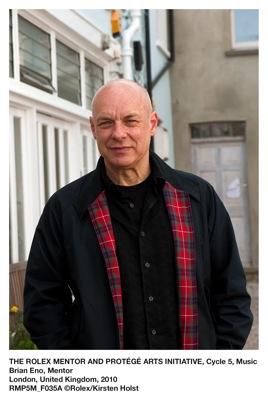
All through the weekend of November 10th, LIVE from the NYPL features programs with master artists including Gilberto Gil, Jessye Norman, Peter Sellars, Anish Kapoor, and Brian Eno. There will be poetry readings, art installation, conversations and site-specific performances,in New York Public Library’s historic public spaces.
Events will include performances by the emerging talents in dance, film, literature, music, theatre, and visual arts who were paired with master artists—Trisha Brown, Zhang Yimou, Hans Magnus Enzensberger, Brian Eno, Peter Sellars, and Anish Kapoor, respectively—for a year of creative exchange by the Rolex Mentor and Protégé Arts Initiative.
The weekend will also feature cross-disciplinary discussions with current mentors Anish Kapoor, Brian Enoand Peter Sellars, as well as Rolex Arts Initiative program advisors José Van Dam and Osvaldo Golijov. Instigated and moderated by LIVE from the NYPL director Paul Holdengräber, the talks willcover a range of topics from mentoring and artistic process to creation and performance. Gilberto Gil and Jessye Norman will also join Holdengräber for one-on-one conversations. Film industry insiders Danny Glover and Peter Scarletwill participate in the weekend as well.
January 29, 2012 画像1
“Rolex is delighted to partner with the New York Public Library to offer New Yorkers the opportunity to engage directly with the art and ideas of this extraordinarily talented group of artists,” said Rebecca Irvin, head of philanthropy at Rolex SA. “Over the past 10 years, the Rolex Arts Initiative has created a community of some of the most inspiring and provocative artists in the world. We have witnessed important, creative collaborations and feel it is important to share that thought-provoking dialogue with the public.
Paul Holdengräber, Director of LIVE from the NYPL, said: “LIVE from the NYPL’s charge is to provoke conversations, offer cognitive theatre, encourage debate, present irresistible performances, and celebrate original ideas. We look forward to speaking with the master artists who have participated in the Rolex Arts Initiative, as well as presenting many of the world and U.S. premieres of work by the emerging artists who were protégés in the program this year.”
January 29, 2012 画像2
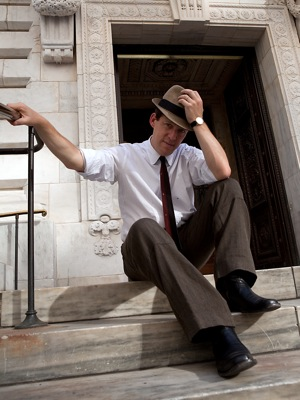
Paul Holdengräber, Director of LIVE from the NYPL/ Photo Credit: Jocelyn Chase
“We are thrilled to align our mission with Rolex in promoting artistic collaboration,” said Joy Stocke, Editor-in-Chief of Wild River Review,” and look forward to featuring both established and new artists from the mentorship program in the pages of our international literary publication. This cultural exchange is too often underestimated in the popular conception of true artistic growth. We applaud LIVE from the NYPL and the Rolex Arts and Protégé Arts Initiative.”
TICKET INFORMATION: Tickets for all events are $25 for the general public and $15 for students/seniors/Friends of the NYPL.Tickets can be purchased through the website:www.rolexartsweekend.com. For more information about LIVE from the NYPL, visit www.nypl.org/live.
Proceeds from LIVE from the NYPL presents the Rolex Arts Weekend will benefit the New York Public Library.
About the Rolex Mentor and Protégé Arts Initiative
In keeping with its tradition of supporting individual excellence, Rolex gives emerging artists time to learn, create and grow. The Rolex Mentor and Protégé Arts Initiative pairs together promising talents with world-renowned masters in six artistic disciplines—dance, film, literature, music, theatre, and visual arts—for a year of one-to-one creative collaboration.
Since its launch in 2002, the Rolex Arts Initiative has built a remarkable artistic community that connects artists from around the globe. Past mentors have included Toni Morrison, Sir Peter Hall, Wole Soyinka, Pinchas Zukerman, Julie Taymor, Mira Nair, Anne Teresa De Keersmaeker, Martin Scorsese, John Baldessari, and a host of other notable figures. For more information, please visit www.rolexmentorprotege.com.
About LIVE from the NYPL
LIVE from the NYPL is a series of vigorous and provocative conversations, debates, and performances at the New York Public Library curated by Paul Holdengräber, director of LIVE from the NYPL. Participating speakers in the recent seasons have included Ferran Adrià, Reza Aslan, Paul Auster, Tina Brown, Edwidge Danticat, Angela Davis, Shepard Fairey, Umberto Eco, Frank Gehry, Werner Herzog, Christopher Hitchens, Jay-Z, Maira Kalman, Spike Lee, Lawrence Lessig, Bernard-Henri Lévy, Norman Mailer, Javier Marías, Frank McCourt, W.S. Merwin, Toni Morrison, Nandan Nilekani, Keith Richards,
Salman Rushdie, Patti Smith, Zadie Smith, Derek Walcott, John Waters, The Velvet Underground with Lou Reed, Slavoj Žižek, and many others. This Fall 2011 the LIVE from the NYPL includes conversations with Harry Belafonte, Diane Keaton, Rick Rubin and Russell Simmons, Joan Didion, Edmund de Waal, Stacy Schiff, Ariel Dorfman, Tom Brokaw, and many more. To watch short clips of past events go to http://vimeo.com/livenypl. For more information, please visit www.nypl.org/live or email live@nypl.org.
About Wild River Review
The online magazine, Wild River Review seeks to raise awareness and compassion as well as inspire engagement through the power of stories. In a climate of repeated media flashes and quick newsbyte stories, Wild River Review curates, edits and publishes essays, opinion, interviews, features, fiction and poetry focusing on underreported issues and perspectives. Praised for “exceptionally interesting interviews,” Wild River Review has published conversations with many leading writers and thinkers including Orhan Pamuk, Elif Shafak, James McPherson, Alain de Botton, Pamela Tanner Boll, Tiffany Shlain, Saadi Youssef and Per Petterson among many others. To find out more about the female-run literary publication, read: Every River Tells A Story.
FOR MORE INFORMATION, CONTACT: Kim Nagy: knagywrr@gmail.com or Joy Stocke: stockey@mac.com
Comments Off
September 21, 2011
The Suitcase was Stuffed
Filed under: WRR@LARGE — Tags: JC. Todd, The Suitcase was Stuffed, Wild River Review, wildriverreview.com, WRR@Large — joystocke @ 8:04 am
by Ivón Gordon Vailakis, J.C. Todd
The suitcase was stuffed
with scorpions, with clay pots and dirt
roasted corn and fava beans, with pans of warm bronze
of dulce de leche and quince
canvas bulging from the lunges of poisonous snakes.
Our destiny was to be far from the aroma
of plantain and tree tomato
ripened on the lips of roofs.
Our destiny was like my father’s –
a couple of schellings in the pocket pierced by a star
he said goodbye to his father with the idea of detaching himself
like a caracol rooted in chasms of tenderness
no time to take the black doll
whose arm was stitched so often the thread held time
and no time to take the knee socks
I wore on the last day of high school
no time to take the trees I climbed by myself
to the middle of a hive that buzzed between my temples
no time to take the warmth of the popcorn pot
no time to take the way I skipped rope in the courtyard
no time to take
the family album embroidered in cross stitch
destined to the parting
destined to lemon-grass teas
steeped in tears that flushed our hearts
we left with the hot coals of a fate not chosen
we arrived before we knew it
men with fish eyes and the accent of crude ants detained us
you must declare all the dirt that you are bringing
you could be fined
you cannot bring food to this country
you will be fined
defensively we declared our pots of roasted corn and fava beans
we lifted our underthings trembling
and felt what it was to step foot on land not our own
they inspected all we had
and did not pay attention to the snakes.
From that day on
we came to know the destiny of border
to make love to snapshots yellowed
by the distance of their background.
We opened up the suitcase
and from that day on
we cultivated
hummingbirds in exile.
Comments Off
July 3, 2011
Brushing By
Filed under: WRR@LARGE — Tags: Africa, Caroline Sutton, Clinton Global Initiatives, HIV, Hudson River, New York, William Rockafeller — joystocke @ 2:26 pm
by Caroline Sutton
January 29, 2012 画像3
The conference center was all glass and steel, with wide hallways circling the auditoriums and silent elevators encased in glass that glided from floor to floor. Cappuccino bars with plates of cookies dusted with confectioner’s sugar appeared at convenient intervals. In various seminar rooms we sat in tall-backed swivel chairs made of biodegradable materials, safe enough for your child to eat.
It was winter in Cape Town. During the global conference on developing countries, skies were bright, afternoons unusually hospitable. Clouds parted as if on cue from the stage of Table Mountain. Inside the air-conditioned conference center, soft leather shoes skimmed over carpets and business cards slipped from wallet to wallet. At the waterfront below people loitered at Seattle Coffee and Haagen Daz or bunched onto ferries for a ride to Robben Island, a visit to prison cells, and a gusty return through shifting tides. A Xhosa leader sentenced by the British to life tried and failed to negotiate the cold currents, lighting out one night alone. For decades the pancake of metamorphic rock was home to lepers as well as seals, the original residents.
At the conference President Zuma spoke via satellite about economic opportunities awaiting foreign investors in Africa; “The conference serves as a key platform to drive engagement around critical economic issues on the continent and to connect decision-makers,” he said to an audience that included thirty-five Chinese CEOs. Two South African high school students sat primly on stage articulating their goals, one to advance technology, the other to practice law. Graca Machel, Mandela’s wife, spoke about the need for African men to view all women as if they were their own wives and daughters so that entrenched traditions condoning abuse would begin to unravel. Sporting a marigold World Cup jersey, Archbishop Tutu blew a vuvuzela and remarked with a wink that he hoped to see this audience in South Africa again before the 2020 Summer Olympics that Durban hopes to host. We are a family of man, he said to resounding applause. The air buzzed with change, or the possibility of it.
When the session ended, I ambled through street markets hawking T-shirts and beads, saw Gothic churches and well swept parks with banyan trees and palms, Dutch colonials safeguarded by electric fences, and the new stadium gleaming like a spaceship. An acquaintance remarked that the city was nice but didn’t seem very different. She seemed indignant (though relieved) at the high rises and KFC, as if she’d expected to see child soldiers wielding fully loaded AK47 assault rifles and men with machetes as pictured in The New York Times.
I, too, donned my North Face and ventured to Robben Island. The tour guide was a former political prisoner who found it cathartic to work alongside his former guards and eat a sandwich with them at midday. He showed us Mandela’s cell, scrubbed clean and painted white, with a mat on the floor and a big red bucket for water and waste, a door that slid open as if to a horse’s stall. One of the original eight imprisoned with Mandela, Ahmed Mohamed Kathrada, spoke to a group of us, matter-of-factly endorsing that leader’s ethos of forgiveness. During his eighteen-year incarceration the prison took special care to discriminate between people of color: he, as Indian, could wear long pants and socks during the cold winters; blacks wore shorts. Why?
“To remind them they were boys.”
The crowd whispered their indignation.
“Ask any prisoner what he missed most,” continued Kathrada in a voice as temperate as the earth tones he was wearing, “the answer, to a man, was children.” Prisoners protested and fasted for many years before reforms enabled a father to hold his child. I’d thought the answer would be a blanket, sex, meat. But a child changes– is no longer a child–in eighteen years.
We strolled in the sunshine of the prison courtyard and consumed pesto and lemon tarts at a bountiful buffet before heading back to Cape Town, whose high rises glittered against the backdrop of sandstone and shale. Thereafter, I was shuttled on tours from vineyards to Table Mountain, all with dreamy unease and sporadic irritation at not seeing what operated below the veneer of obsequious bellhops and British teas. I wasn’t out to see “the real Africa;” those British teas at the Mount Nelson Hotel were oh so real. But I seemed to be skating on a reservoir in a volcanic crater, and the ice needed to crack. The parks where tourists strolled and blacks in neon vests speared litter with poles were quiet. Through the dark bus windows I saw a crisp new hospital and the stately university standing as it has since 1829 on the Rhodes estate at the base of Devil’s Peak.
Where was the city within the city?
At the final session of the conference, I met a young woman from Bedford, New York, which is about twenty miles from where I live. Initially, I mistook her for an extraneous family member, someone’s daughter, so unassuming was she, standing by the sign-in desk in a black cardigan and boots. She shook my hand, softly, and pulled involuntarily at her long blond hair while I chattered foolishly about New York and stared indiscreetly at her green eyes and heart-shaped face. She had spent a semester at the University of Cape Town and had returned to open a grass-roots center for HIV positive children in the township of Khayelitsha. More astounding, she had raised a million dollars and had navigated the city’s tortuous political system, including negotiations with the township’s mayor, to purchase a tract of land adjacent to the only hospital serving Khayelitsha’s 1.5 million people. Such is the clout of this politician that when drug gangs who’d committed theft realized they robbed her, they voluntarily worked off the debt by cleaning her house, toilets included. Whitney planned to build a new center with storage facilities for medications, a playing field, and a feasible kitchen for preparing a daily meal, as she already did in her existing center, for her 75 kids. The wait list for her center numbered in the hundreds; she had a staff of four.
In cold drizzle the following day, Whitney picked me up at the Mount Nelson in a black SUV. My husband came too, but our friends opted to enjoy themselves by exploring gracious vineyards in the surrounding hills. As a kid I’d visited pueblos on Hopi reservations in New Mexico, which are now closed to tourists; later I’d traveled to India and Indonesia, Iran and Peru. Gawking at poverty was not PC.
And who would benefit? I swallowed that question like a piece of gristle but felt invasive nevertheless as I questioned Whitney about the sordid conditions, lack of in-tact family structure and education, lack of plumbing and electricity, lack of grocery stores and jobs. “I hear unemployment’s 34% in Cape Town.” Did Zuma tell us that?
“ More like 80% out here,” she said, as if easing bad news–the death of a pet bird– to a child.
“Where does anyone work?”
She shrugged and kept her eyes on the road. “Cape Town, maybe, but a domestic, who typically earns $15 a day, pays $6 in bus fare.”
We drove about twenty five miles– five times the distance from the city to Robben Island—passing much-touted one-story cement houses you get if you essentially win the lottery; thereafter stretched miles and miles of corrugated tin shacks wedged together like crooked teeth. Empty bottles, orange peels, plastic bags lay roadside. Later I stepped over barbed wire and a dog skull. Meanwhile Whitney answered our questions matter-of-factly, if guardedly at first.
“There are no toilets?” I asked, wondering where I was going to go.
“The government supplies Port-o-Potties. The people think they’re a joke.”
“So?”
“They have buckets, but the shacks have no floors so when it rains they flood.” She turned to me, raising her lovely eyebrows.
“Oh.”
By now rain was coming down in droves, and her wipers were on high speed. Through vapor like cataracts I saw shacks with no windows–wood, tin, bright paint, weathered numbers– shirts hung to dry, collarless dogs all generic brown, stands selling oranges and bananas, only oranges and bananas, a few women with blankets around their shoulders to ward off the rain. For the most part only children looked back at us.
The SUV took a sharp turn inside a wire fence and stopped at what looked like an abandoned garage. Inside, a Yale business school student with evenly cropped blond hair and a body toned by varsity lacrosse greeted us enthusiastically. Another young woman from Chappaqua sat sniffling at a laptop in the chilly communal office space, while an older woman, a social worker from the township typed on a desktop and rifled through papers. Whitney could not operate without some local staff—“too dangerous,” she conceded– and she based her center in a Methodist church, whose members also provided some protection. The cavernous room was like the belly of a whale, with exposed beams in a half-finished ceiling, dark wood walls, few windows. Whitney looked down at the brown linoleum and quietly noted she’d had that installed. “You should’ve seen this place before.” We stood among haphazard chairs under dim overhead lights waiting for the kids to arrive, but the bus broke down and only a few straggled in. At the far end a woman hunched over a puzzle with three small girls, scarcely moving, somehow holding their attention. A cluster of boys sat around an electric heater watching professional wrestling. “Usually I never let them watch TV,” chimed Whitney. They danced, played games, went to a museum, did yoga. Four year olds learned how to take medication themselves because no one reminded them, or no one approved. A social worker counseled a teenager on the stigma of HIV, another on sexual abuse by a mother’s boyfriend. Only one of the 75 kids had a father at home. Some lived too far from a water spigot to take their pills. One boy always smuggled bits of his meal home to his siblings under his shirt. “He’s not usually shy,” smiled Whitney as I shook his fine-boned hand. Another boy arrived with the seat of his cotton pants torn– routinely abused.
Did they wonder what I was doing there? I wondered what I was doing there, but didn’t want to be elsewhere, for the moment. We stood talking with Whitney for some hours while the rain clattered on the roof and pummeled the mud. Her staff brought a plate of spinach and bean stew to each kid, one at a time, from a kitchen (smaller than Mandela’s cell) with a tiny refrigerator, two burners, and a shelf harboring brown paper bags and two heads of broccoli. Acid worked at the inside of my stomach, but I figured I’d wait till I got back to the hotel.
When the clouds running overhead left a listless grey cover and the rain relented, we left the center and wound through paths between tin homes. We stepped over dog feces and broken glass, brushed past occasional men, always alone. “Don’t flash a camera around,” Whitney warned. I wouldn’t have been able to find my way out. Little boys stared and grinned. At length we reached a square opening with a spigot and called out at the doorway of one of the homes. I remained near the door while Whitney and her social worker went in, the latter chatting in Xhosa to a woman holding a baby. The walls were lined with newspaper; a kerosene lamp stood on a board attached to the wall; an electric wire dangled fruitlessly from a corner of the ceiling, not a foot above my head. One bed. Children slept on the cardboard floor. Three adult women, no men. I smiled and looked mostly at my feet. A plump girl in pink sweatshirt and sweatpants, who had raced up to Whitney when we arrived, still clung to her, arms locked around her torso, nose crusty and running. For years the family had thought she was mute. A boy tried on black leather tie shoes we brought, and I thought they looked hard and ungainly jutting from his slender ankles. He soon took them off, placed them carefully side by side, and slid his feet into flip flops. Did they fit? He nodded. We thanked everyone, called out cheery goodbyes, smiled, waved, and soon left.
I followed, asking no questions about where we’d go next. That way I’d appear easy going, as if I did this kind of thing every day, as if we were one family, as Tutu had said. Perversely, I validated the marble bathrooms and lavish breakfasts at the hotel because I was also seeing this; in the same breath, I condemned it all, the displacement of millions, the morass of shacks stretching in perpetuity beyond the shadow of the new stadium and the unabashedly colonialist hotel with its etchings of British military men standing at attention, brass cannon in the hallway, kudu antlers on the walls, warm fireplaces and cozy high teas, egg salad sandwiches with the crusts cut off and butterballs that someone had to make…. Worst of all, I found myself wanting to leave, wanting to eat one of those sandwiches.
I left nothing in the township except a smile and a pair of shoes I didn’t buy–and whatever reaction my presence provoked, if any. What did I take, I who already had a job, a plane ticket, a wardrobe of cashmere and silk? Photos I snapped on the sly like a private detective and images to transcribe arbitrarily into words for you—but do you see what I see? And what then? Back at the hotel the doorman opened the door, and the concierge standing tall in her tan pantsuit smiled broadly. I had coffee in the bar, skirting the immense display of watercress sandwiches, custard tarts, and chocolate truffles laid out for high tea. The same waitress I saw each morning brought a tray with a starched napkin and far too many utensils for a cup of coffee. She remarked that the weather was likely to clear. Such optimism! I wondered where she lived, what time she got up to start serving by 7 am, what she thought about our cordial greetings, but I chattered as if I didn’t think about these things.
Later I told my friends about the township, the kids, the disease.
“Anything like Calcutta?”
“Worse,” I replied with earnest fatigue, as if I’d just gone without food and water and slept in the mud, as if I’d just survived.
“We wish we’d gone,” my friend replied. “ It rained and the view from the vineyards was lousy.”
***
One night the members of the conference split into groups of about thirty and were bussed to different sites throughout the city for dinner. One group went to Cecil Rhodes’s mansion, which is closed to the public. Ours drove forty-five minutes along the coast to the home of Eric, head of a human resources consultancy, and his wife, Mary. French doors opened onto a balcony overlooking Table Bay sparkling in moonlight like a Hollywood set. A striking array of oil paintings hung in the dining room where four parallel tables were set with white tablecloths for the occasion. We were seated and wine was poured. At my table was Jeff Berger, an anthropologist who found skeletons in the Malapa Cave north of Johannesburg which, he claims, are 1.9 million years old and will forever change our concept of the origins of hominids, subsequently, the family of man, though I couldn’t get him to say exactly how. Asked why human life started in Africa, he responded, simply, it’s the biggest landmass in the world. You could plop North and South America and China and Europe inside it, an image that sent ripples of surprise around the table. Our hostess went around the room asking each person—members of the conference only—who they were and what they did. We heard from brilliant wind and solar energy entrepreneurs and the creator of bubble wrap who works out of New Jersey but said New York.
While individuals introduced themselves, “colored” women served huge platters of beef, whole fish, pumpkin ravioli, smoked salmon, and salad to each of us, after which Mary said she had a surprise. I’d noticed a young man standing just inside the living room, dressed in black slacks and a short-sleeve collared shirt, smiling and nodding as we arrived—he might have been the only person of color not in the kitchen. Now, with anticipation evocative of Christmas, Mary presented her protégé, of sorts. She had helped sponsor his violin lessons. He had studied for two years and made exceptional progress. He was eighteen though given his five-foot height and willowy limbs I would have guessed twelve. With her maternal arms around him, Mary narrated snippets of his childhood in the township, citing his many siblings and his will to attend school, hunger and ever-present danger from gangs. He then raised his bow, cocked the violin on his shoulder, gazed over our heads, and performed a classical piece for us that was so familiar, followed by something slow and lyrical that I had never heard. He dedicated it to Mary and played with such ardor that tears came to her eyes. This art, too, was hers. We applauded her generosity and his talent, and he thanked his sponsors warmly for his many opportunities. In the air was a giddy optimism veiling vestigial colonialist sensibilities: they too can rise. But he was one, and we were so many.
****
Waiting at the Cape Town airport for the 22-hour trip home, I leafed through Fortune. More poverty. But GDP grew 4.9% in Africa from 2000-2008! I tried to see, concealed in that figure –the triangular 4, the circular 9– another bowl of soup, another pair of shoes, a lightbulb lighting a shack, a woman with a raincoat. There was land to farm, diamonds, uranium, and manganese to mine, a hydroelectric dam to build on the Congo that could supply all Africa with energy, fiber optic cable to lay throughout the east and the south. It was Cecil Rhodes, redux.
Back in New York, I often think of the township. On land formerly owned by William Rockefeller that tumbles down to the Hudson River, I walk my dog with the joggers and picnickers. It’s summer and the grass has gone brittle and yellow in the drought. August is the coldest month in Cape Town and the rainiest, the time when Khayelitsha, floods and the sun retreats by five. I pass three men speaking Japanese and carrying enormous cameras, not in their cases, cameras with lenses that will capture this park as I have not seen it. I’ve contacted the school where I teach and asked them to invite Whitney to speak to raise money for her center. The request was met with enthusiasm, followed by an email outlining the difficulties of scheduling time at morning assembly, what with speeches by the new representatives of community service, and all. And that email betrayed not the slightest touch of irony.
What then.
I replay scenes and reactions– a young man who brushed by me in the alley between homes, a dog ripping at a plastic bag, a slightly cross-eyed boy, the tangy smell of urine. Of course I wanted an egg salad sandwich that day. Who wouldn’t? But why would I think not wanting one at that moment would make me more empathetic, more transcendent, more integrated in the scene–and that would suffice?
Unlike Whitney, most of us mortals cannot—or do not want to–pick up and start another life halfway around the globe. When my daughter, who is Whitney’s age, exclaimed, “Can I work at the center?” I flinched. I saw her walking the labyrinthine township with her ingenuous smile, taking a wrong turn, catching looks, and worse. Port-o-Potties are used for gang rapes. Maybe I wouldn’t let her go; maybe it was a passing whim. “I’m sure there’s a lot you can do from New York.”
At the conference Bill Clinton said to his audience of empowered people, “You can always find a reason not to do something.” This child ravaged by HIV will not live, three doctors told Whitney. You might as well go home. For that reason she and her staff stayed with him twenty-four hours a day, and for that reason he had something that day to live for. Repeatedly she told me, “This is what I’m meant to be doing.” The very reasons not to be there constitute the reason she is.
Comments Off
May 9, 2011
PEN WORLD VOICES: Wikileaks – Is Raw, Unfiltered Data Useful?
Filed under: WRR@LARGE — Tags: Cooper Union, Michael Shareshian, PEN World Voices Festival, Wikileaks, Wild River Review, wildriverreview.com — joystocke @ 8:25 am
PEN WORLD VOICES: Wikileaks – Is Raw, Unfiltered Data Useful?
by Michael Shareshian
As part of the 7th annual PEN World Voices Festival of International Literature, The Cooper Union in New York City hosted a panel discussion featuring opinions and perspectives regarding one of the most complex and important issues facing our global society: Wikileaks.
Is raw, unfiltered data useful? Do forums like Wikileaks need traditional outlets? Are leaked cables leaking what is already known? These, among many other topics, were discussed by Human Rights Project’s Tom Keenan, media theorist Geert Lovink, Professor of Democracy Ian Buruma, and policy analyst David Rieff.
Presenting his theories first, Mr. Lovink deemed the leaking of classified documents to be a rapidly developing and highly influential genre of journalism in and of itself, “data journalism.” Lovink argued that young people with technological capabilities will continue to develop such forums as they evolve and play an increasing role in our information delivery and digital infrastructure.
Ian Buruma sees Wikileaks as having less influence than some may perceive. Buruma noted that Wikileaks’ cables needed the mainstream press in order to have any impact at all.” Referencing established outlets such as The New York Times, he stated that people like Julian Assange depend on traditional sources in order to lend credibility and perspective to data. According to Mr. Buruma, raw data is of very little use to the public. Only when qualified individuals interpret it can it become something useful and understandable. He acknowledged a commonly held complaint that not everything on the Internet is trustworthy, and asked the question, whom should the public trust without the filter of reliable fact-checkers?
Like Mr. Buruma, analyst David Rieff downplayed the influence of Wikileaks for different reasons. As he sees it, much of the leaked cables contain information that is already available in the public sphere. While he made it a point not to downplay the questionable, and at times deplorable, actions of governments around the world, how influential can “document dumps” be when the information they contain are simply reinforcing what is already known?
During a question and answer session, an audience member challenged Mr. Rieff’s assertion that the public at large is as informed he assumes them to be. This questioner drew attention to a leaked cable that revealed the lesser known occurrence of CIA officials interrogating a cameraman in order to learn more about the operations of Al Jazeera.
Perhaps the most important issue that needs to be addressed by the public at large is how do documents revealed by secret sources affect safety. Can transparency and protection of national security coexist?
Are “leakers” like Bradley Manning noble whistleblowers or a danger to our citizens and soldiers serving around the world?
The discussion continues…
Michael is Wild River Review’s newest intern. He studies English at New Jersey’s Rider University where he enjoys hosting his own weekly radio show.
Comments Off
December 3, 2009
Producing Peltier: Walking the Red Road to the Red Carpet (Part One)
Filed under: WRR@LARGE — Tags: Arvol Looking Horse, Kevin Costner, Lakota, Paul Soderman, Producing Peltier, Warner Brothers, Wild River Review, wildriverreview.com, WRR@Large — joystocke @ 5:19 pm
Producing Peltier:
Walking the Red Road to the Red Carpet (Part One)
by Paul Soderman
…Let it be known that Leonard Peltier is a spiritual warrior who shares the heart of our ancestors who fought for the rights of our people, such as Crazy Horse and Sitting Bull. As a Sun Dancer, he has sacrificed his life to the People, so they may have happiness and peace once again. I pray that his words become etched in the minds and hearts of all people and that the wounds on his soul heal. And I ask those who continue to inflict such pain and suffering on him to see the error of their ways. Let us all work together to restore justice so that the hoops of Our Nations can mend and our children may see better days…From Introduction by Arvol Looking Horse – Leonard Peltier, Prison Writings: My Life Is My Sun Dance
January 29, 2012 画像4
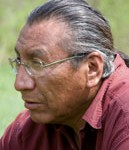
Mr. Arvol Looking Horse, 19th Generation Keeper of the White Buffalo Calf Pipe
Here at Warrior Artists, as Cathie and I enter into pre-production work on the Leonard Peltier movie, we are reminded of the last decade, how mysteriously connected events and circumstances have lead us here.
I remember Los Angeles fondly, the 18-hour production days I worked as I reluctantly accrued “permit” days as a Union Grip. I earned my hours mainly from accepting numerous 3 a.m. calls from Sony Studios, usually to rebuild the backdrop set of the television game show, Wheel of Fortune. While crawling under that infamous wheel with a ratchet, I had a fortunate moment of clarity. I suddenly realized that I had no desire to become a Union Grip.
Meanwhile, Cathie landed a coveted Executive Assistant position on the Warner Brothers lot for a very benevolent, old school Director. He was the quintessential Hollywood ‘Mensch’ and the daily office parade of the wildly famous, soon-to-be-famous and used-to-be-famous, along with their attending sycophant media peddlers, made for entertaining coffee shop talk among the envious and unemployed actors we hung out with.
While I drove truckloads of scenery flats all over town, Cathie scored a Production Assistant (PA) spot on Lethal Weapon 4. PAs are the worker bees of the movie world with absolutely no rights… As the less than cordial “boss” sent Cathie on wild goose chases to secure the “right” donuts each a.m., I swear I saw her Ivy League, MFA Degree cringing on the wall.
While printing “call sheets” for hours for LW4 Cathie camped out by the back door of the office, which opened to an empty alley. Every day, Kevin Costner walked right by her, but in Hollywood part of the unspoken ethic when working on a studio lot is, “when encountering an actual Movie Star, be cool and always act as though it’s no big deal.” She did her PA job humbly and so they never spoke.
Shortly after their ‘close encounters’, while at a stoplight, again in front of Warner Studios, Mr. Costner walked right in front of my grip truck. I’d seen a few movie stars by now, but somehow that guy’s physical presence could stop time…But hey, no big deal.
Lethal Weapon 4 wrapped and Cathie and I took our meager Christmas paychecks straight to the computer chop shop to bring home our very first PC. By now we knew exactly who had the coolest job in Hollywood. Writers rule. We spent the entire holiday hiatus, 10 days straight, co-writing our first Original Screenplay, Fallen Warriors. The entire story had descended upon me while waitig at that same exact stoplight in front of Warner Brothers Studios while listening to sports talk radio in my scenery truck.

January 29, 2012 画像5
Warner Brothers Studios Gate 8 (Power Spot) (Photo Joe Kolias)
At Reservation ceremonies we attended, we had met a few of the Native American actors from Dances With Wolves (which starred Kevin Costner) and had written a principle part for the young Lakota who had played “Smiles-A-Lot” in the film. When he read the screenplay he was very moved and invited us to visit him and his family in Rapid City, South Dakota. Cathie and I hit the road as my pager went off summoning me back to what we now called Wheel of Torture. I tossed that pager into the back seat and never went back.
Eventually we returned to settle in our beloved Boulder, Colorado. One day, our friends from South Dakota called saying they needed us back. Their old friend Kevin Costner was calling for a meeting with them. It seemed he wanted ”permission” to install a massive sculpture of Buffalo on his land in the Black Hills, and set up a Lakota Cultural Center called, ‘Tatanka, Story of the Bison.” I was impressed with his effort at respecting the protocol of ‘asking before doing’ in Indian Country.
Our Lakota friends had instructed Kevin to seek the counsel and blessing of Arvol Looking Horse, the 19th Generation Keeper of the Original White Buffalo Calf Pip – the most Sacred object of the Lakota people. They said, “Paul & Cathie, you should come with us. That way Kevin won’t be the only Washichu (white guy) up there.”
We bravely accepted our role as “Cross Cultural Tour guides” and prepared for the pilgrimage to the Holy Place of Green Grass, SD.
We watched Costner’s sleek Gulf Stream jet, featuring the Warner Brothers logo on its tail, taxi into the private terminal of Rapid City Airport. Kevin disembarked alone with an overnight bag and a very old Pendleton Blanket folded under one arm.
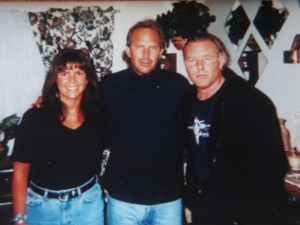
“I feel like I’ve come back home,” he cheerfully offered. He extended warm handshakes all around and gave Cathie a hug and kiss on the cheek. Now that she had been properly introduced, her mind suddenly traveled 2000 winding miles, to that back alley of Warner Bros. Studio. As she thought: “But, you can’t get here from there,” I was thinking, “We may not know where we’re going,but we sure ain’t lost.’
January 29, 2012 画像6
Cathie and Paul Soderman w/ Kevin Costner (Photo J. Chasing Horse)
Next: Roaming the Black Hills with Mr. Costner…Paul Soderman was born in NYC and raised in Princeton. After an inauspicious start to young adulthood, Paul survived a cataclysmic conversion experience and subsequently focused his energies in helping youth, working as a drug and alcoholism counselor for the NJ Dept. of Corrections. Wanderlust drove Paul from NJ, and while traveling throughout the American West, he simultaneously discovered an intense interest in Native American culture and a genuine talent to sing the Blues. He spent the next 15 years as a fulltime musical performer and frequent visitor to numerous Indian Reservations. After meeting his future wife Cathie in Telluride, Co., a Theater Director from New York , he became fascinated with Film. Combining an interest in all things Native American and Artistic, the Soderman’s started their Production Company, Warrior Artists producing numerous projects. With their partners at Elevate Films, they have been given the honorable opportunity and responsibility to produce the feature film PELTIER based on the book by Native American Federal prisoner, Leonard Peltier, Prison Writings: My Life Is My Sun Dance. Paul currently resides in the foothills outside of Boulder , Colorado with his Wife Cathie and their beloved Golden Retriever, Auggie.
January 29, 2012 画像7
December 10, 2009
Life’s a Mystery. By Joseph Glantz
Filed under: WRR@LARGE — Tags: America, Bostwana, Detectives, Joseph Glantz, London, Monk, Mystery, Rockford — joystocke @ 11:06 am
For many the evolution of man/woman can be seen in poetry, fiction or non-fiction. In politics and art. Going to the theater. My adult introduction runs differently. From the time I was given a collection of Sherlock Holmes stories for my bar-mitzvah I’ve always been fascinated at how we can learn so much from the modern detective story. Aside from the sophistication of the crimes and the cleverness of the telling of the clues, the essence of any detective story is the actual detective. They’re human in ways that always amaze.
While other British detectives relied on emotion Holmes set himself apart in stories because he super-reasoned the clues that escaped others. Soon after – I learned that the detective story wasn’t confined to just writing. Wayne and Schuster, two Canadian comedians, did a wonderful take on detectives in the age of Julius Caesar. Who really did have motive to kill Caesar and the means? Dragnet’s Joe Friday asked his television witnesses for “Just the facts, ma’am.”
Other detective stories added additional character traits. Detective Columbo had just that one more question that got under people’s skins. Jim Rockford was the practical detective. He didn’t use a gun, though he kept one in his cookie-jar just in case. My favorite episode was the one titled “Rose N. Krantz and Gilda Stern are dead.” Richie Brockleman got people to talk because he was “nice.” Lance White, portrayed by Tom Selleck, was the detective who played by the rules. Rockford thought Lance was a sucker. Selleck later made sleuthing “cool” in his Hawaiian Magnum series.”
Angela Lansberry’s Jessica Fletcher and and Agatha Christie’s Miss Marple showed that women could be just as good at solving mysteries. Bill Cosby’s I-Spy showed that blacks could be crime-busters too
Along the way these detectives have had different professions which have given them that unique edge. Ms. Fletcher was a writer. Lisa Scottoline and William Lashenr write from the vantage point of ex-lawyers. Prime Suspect’s frayed and sometimes fried Jane Tennison, played beautifully by Helen Mirren, was a police detective. Mystery on British PBS seems to have a special fascination for police sleuths with a fascination for events surrounding World War II. Martina Navrotilova’s detective was a former tennis player. Maybe modeled after Alice Marble, a real tennis player was also a real spy. In Arturo Perez-Reverte’s mysteries artists and fencing masters are the sleuths.

January 29, 2012 画像8
David Liss’s detective in the Conspiracy of Paper was a Jewish boxer when the stock markets were beginning in London. Jill Scott, as an African native in the … Ladies’ Detective stories, lets me know about Africa (Botswana). Others use time travel to solve the case.
In movies, detectives like those played by Bruce Willis and Sylvester Stallone, are larger than life figures who rely on their brawn. Though Willis made his fame pairing with a woman, Cybil Shepherd, which was noteworthy for the gender pairing and the notion that detectives could have a sense of humor. Sam Spade as Raymond Carver literature was great. Sam Spade as played by Humphrey Bogart, even better.
The most recently retired detective was Adrian Monk, who suffered by Obsessive Compulsive Disorder but was a savant in spite of or perhaps because of his disorder. From the opening show where he had to use wipes to climb a ladder to the last where those same wipes contained the poisonous residue that put his life in danger helped to save his life (because the chemicals could be extracted), the compulsiveness was character building. Monk made all the people around a little more human in dealing with his disorder. I loved that the show ended with happy endings for all. A compulsively neat solution.
In this age of the computer there’s sure to be a detective who uses Twitter and Facebook. Shouldn’t there be a series where a reformed cook the books accountant stars. There’s bound to be a mystery version of the Martian Chronicles, a geriatric problem-solverand well, I have to stop writing. There’s a new Sherlock Holmes movie coming out. A dark Mr. Holmes – Oh My! Sue Grafton’s alphabet mysteries are down to the letter U. Will she stop at Z? Garrison Keillor’s Guy Noir just landed in a new city. Maybe yours?
Life and death stories. Oh sure somebody always dies, but they’d eventually die anyway and the best part about mysteries is that the good guys solve the case and the bad guys go away. And Oh Sure, there’s the opera, the theater and the ballet – but come to think of didn’t the Fat Lady just sing her last aria (I suspect Jake and the Fat Man), didn’t that actor enter stage-left when he should have entered stage right (hmmm?) and really, how do those Nutcracker characters come to life ?
Mystery. When one door closes a life a window into the human condition opens. Here’s what happens…
Comments Off
December 21, 2009
Bah, Humbug! Oh, What the Hell…
Filed under: WRR@LARGE — Tags: Charlie Brown, Desk Jockey, Facebook, New York, New Yorker, Rockefeller Center, Wild River Review, wildriverreview.com, WRR@Large — joystocke @ 10:09 am
Bag, Humbug! Oh, What the Hell…
by Desk Jockey
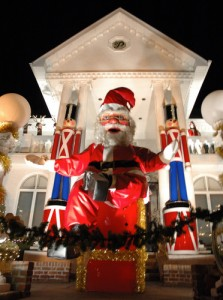
A New Yorker’s grouchy take on the annual rite popularly known as Christmas
January 29, 2012 画像9
With nearly 1,000 friends on Facebook, Desk Jockey marvels at the number of status updates people start posting about Christmas—in October.
“Today, Heather baked chocolate pumpkin surprise cakes!” crows one proud mom. “We got out the snow blower and made snow angels all morning!” boasts another.
Like Charlie Brown (his mentor whom he discovered over 40 years ago), Desk Jockey has found that Christmas is not really about anything as sacred as the birth of Jesus. It really is about puppies and cupcakes and children—three things that are as incomprehensible to Desk Jockey as Dari, the language spoken in Afghanistan.
Even more regrettable, in New York, Christmas isn’t just confined to a manger, or a blue spruce, or Rockefeller Center. It’s everywhere.
Lots of decoration. Lots of jingle.
If there were no such thing as the North Pole, New York would be declared the capital of Christmas.
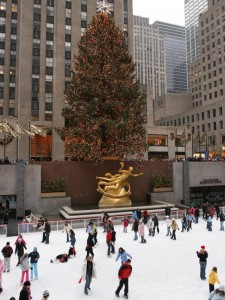
Besides “the tree” at Rockefeller Center—whose delivery and lighting are treated second only in importance to the birth of the Christ child—there are Christmas tree stands on every corner beginning in late November, stocked with trees of every size, costing hundreds of dollars or more. Ka-CHING!
Special “farmer’s market” mini-malls are set up at strategic points around the city like Columbus Circle and Union Square. Besides young couples holding hands, they are filled with the most god-awful art and trinkets that you wouldn’t buy if they were reduced 90 percent and endorsed by Doctor Oz.
The Macy’s Thanksgiving Day parade, as the entire country knows by now, isn’t really about Thanksgiving. It’s an excuse to sell tickets to Broadway musicals during the Christmas season—besides being an excuse to jack everyone up for door-busters on Black Friday, and three days later on Cyber Monday.
January 29, 2012 画像10
That question, again.
Worst of all, Christmas is the time of year when that most irritating question of all is used as a conversational ice-breaker, “So…what are you doing for the holidays?”
Most New Yorkers are smart enough to think of a stock response weeks ahead of time. “I’ll be in the country,” they say loftily, which could mean anything from Chappaqua to East Hampton to Wisconsin.
Some New Yorkers are really, really enterprising, in that they actually make plans to go away—as in several continents away—for Christmas. Not for them, the plumpish, badly dressed suburbanite hausfraus crowding their sidewalks, accompanied by squealing children wearing New York Giants jackets. No, the smart set are rubbing their well-toned elbows and flashing their heart-monitored pectorals with the hedge-fund crowd in Anguilla and Gustavia, Saint Barths.
Partying hearty, New York-style.
For most New Yorkers, the greatest reason to have a Christmas holiday at all is to have an unlicensed right to drink, drink, and drink some more.
Witness the parties that start soon after Thanksgiving. (Desk Jockey himself throws one, his major nod to the holidays.) Menus are devised as early as October, guest lists are composed, discussed ad infinitum, written, thrown out, then written again. Invites are emailed with the precision of a wedding planner—“first wave” responses, followed by “second waves” should the first waves bail, and even third-wave responses if you’re really afraid of no one showing. Cater waiters are engaged, and bartenders—only the best-looking of course!—are hired.
New Yorkers never tire of bragging about how many Christmas parties they’ve attended, or how tired they are, never for a moment connecting the dots. They are wont to brag about meeting Sean “Puffy” Combs at one party, or Apple’s ex-co-founder Steve Wozniak at another, and then mentioning it ever so casually on Facebook for their 980 friends to see (okay, Desk Jockey has done that, too.)
Doorman tips: give plenty of $$. Not food.
Christmas is also the time when those of us crammed into our 780-square-foot cubicles (a.k.a. apartments) are treated with a level of respect afforded only the Sultan of Brunei or the late Michael Jackson. Doormen are basically all over you, beginning right after Thanksgiving. They buzz the elevator door open when your hands are empty; laugh more heartily at your dumbest comments, and are especially quick to change the light fixture that’s been out for weeks.
Desk Jockey knows that these men and women are not masters of the universe; in fact, they typically earn a salary he earned 35 years ago. His sympathy for them, coupled with his bleeding-heart Manhattan liberalism, induces him to tip all eight members of his staff far more than he knows his rich banker neighbors are giving.
This does not go unnoticed by the staff. One summer, the superintendent asked Desk Jockey, “Why are you different from every one else here?” Feeling sure he was referring to his generosity at Christmas, Desk Jockey answered, “Because they’re richer than me.”
Time to take a break? Really?
As faithful readers may have gleaned by now, Desk Jockey, like many other blasé New Yorkers, regards Christmas as just another day. Gifts? Desk Jockey can buy anything he wants for himself (save an $11,000 bicycle) any day of the year. Kindness to others? Desk Jockey observes this policy every day of the year (admittedly, in New York City, it can be difficult.)
To Desk Jockey, Christmas is an opportunity for the higher-ups at his widget firm to relax and shut off their PDAs—but not before they email their junk to his desktop, tell him the due date is January 3, and turn on their automated “Out-of-Office” Response before he can ask any questions.
Desk Jockey cannot remember a single Christmas season that he did not work every day of the Christmas “break.” He does remember being buzzed on a cell phone as he walked into Midnight Mass one year, asking him to make a change to paragraph 3 on page 16. On the day after Christmas, he remembers driving his broken-down Honda through a blizzard, then digging a path through three-foot-high snowdrifts blocking the door of his Connecticut office, just to finish a project that was due January 2.
He also famously remembers daring to turn off his PDA on New Year’s Day one Christmas to go to the movies. On January 2, he turned it back on, only to get an all-caps, nasty-gram email which read, “WHERE WERE YOU YESTERDAY?”
The project’s decision date was January 5, and to this higher-up, our winning the work would save the entire empire from certain destruction.
Turns out, the decision wasn’t made until eight months later.
If you can’t beat ‘em, celebrate ‘em.
As the saying goes, laugh and the world laughs with you; cry, and you cry alone. Desk Jockey, who would positively perish if he did not have his 980 FB friends and their status updates, wants to assure his faithful Wild River Review readers that certain things about Christmas do make him very happy.
1. His annual holiday party. This always takes place the first Friday in December, so that Desk Jockey can have the rest of the month to pursue other activities, such riding his bicycle in the freezing cold.
2. The Christmas windows at Barney’s. Imaginative and witty, they are the brainchild of Simon Doonan, the decorator and columnist for the New York Observer, whose attitude toward life is as snarky and unforgiving as Desk Jockey’s.
3. His favorite new book about Christmas. It’s You Better Not Cry by Augusten Burroughs, whose opening essay on a child confusing Santa Claus with Jesus Christ is classic.
4. The fact that Desk Jockey has over 10 extra vacation days he cannot carry over to 2010. He especially relishes telling his slave-driving boss this fact, and hopes she will not turn her oblivious ear to him, as usual, and give him a new assignment due January 2.
And finally, there are those Christmas “moments.”
When Desk Jockey thinks he cannot take another sidewalk Santa, or hellacious day at work, he will walk by some store window decorated for Christmas, and hear Leroy Anderson’s “Sleigh Ride.”
Hardened, seen-it-all, cynic that he is, Desk Jockey just melts.
January 29, 2012 画像11
Desk Jockey is a regular columnist for Wild River Review. He has worked for major advertising firms for more than 25 years. He is now an account executive for a widget manufacturer. Desk Jockey is an avid cyclist, logging hours in cities and countrysides around the world. To read his latest column, click here: Duathalon Man
January 3, 2010
Eat, Pray, Love, Commit
Filed under: WRR@LARGE — Tags: Committed, Eat Pray Love, Elizabeth Gilbert, Joy E. Stocke, Joy Stocke, Liz Gilbert, wildriverreview.com, www.wildriverreview.com — joystocke @ 7:50 pm
by Joy Stocke
January 29, 2012 画像12
New Year’s Day in Lambertville, New Jersey at the home of Kevin Wentworth and Aba Boehm downriver from Liz Gilbert and her husband Jose Nunes’s home in Frenchtown. Friends are gathered in the dining room and kitchen eating Aba’s vegetarian chili and corn chowder in celebration of the group’s annual dunk into the mist-covered Delaware River.
Nunes arrives into this mix of artists, writers, business folk and yoga practitioners, bearing wine and apologizing for his wife who is sitting in the car finishing a phone call related to the much-anticipated follow up to her wildly successful memoir, Eat, Pray, Love.
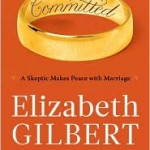
Gilbert’s new book, Committed: A Skeptic Makes Peace with Marriage, arrives in bookstores on January 5th and chronicles how she and Nunes (Brazilian-born with an Australian passport), both divorced, vowed to remain committed to one another without a marriage license. That is until Homeland Security refused Nunez an re-entry visa into the States.
Because the pair wished to settle in the States – yes, all you comedians, they chose New Jersey, the Garden State – Gilbert and Nunes married. And so begins Gilbert’s tale, a meditation on the meaning of and what it takes to create a marriage.
On New Year’s Eve after a busy week of sales, she and Nunes closed the store they set up and run together, Two Buttons Imports, for a two month hiatus and were in bed by 9:30 pm in anticipation of a very busy January and February.
When Gilbert’s book tour begins on Tuesday in New York City at the Barnes & Noble on Union Square, Nunes will already be in the Dominican Republic with his daughter who is visiting from Australia; and then on to a buying trip for Two Buttons, which will take him to Bali where Gilbert met him.
And Gilbert? She rushes into the dining room her cheeks flushed from the cold, apologizing for her tardiness, then asks, “Did anyone actually jump in the river?”
When a number of folks, including the youngest swimmer, all of eleven years old, nod in the affirmative, she shivers. “I hate being cold,” she says. “See, I have goosebumps on my arm,” and then reaches for a chocolate covered cherry.
After she graciously receives congratulations about the release of her new book, I ask whether she’s nervous. She looks up from her half-eaten cherry and says, ”You know, the expectations are so high for this book that I can’t possibly meet them. So, yes, I’m nervous to the point where I’ve had a few sleepless nights.”
Nunes eyes her protectively, “I tell her not to read a single review. I will read them first. And she is NOT to read anything on Amazon because sometimes there are crazy people who write unkind things.”
Now, I have to admit I’m having an almost out of body experience during our conversation. Can one of the best selling authors of the 21st Century really be that nervous?
Well, the answer is absolutely, yes. Even with positive early reviews, the immensely gifted Gilbert – her book, The Last American Man was a National Book Award Finalist – is waiting to hear from her readers.
She does have a wish though, one that has a good chance of coming true: “I’ve never asked people to buy my books before,” she says. “But this time I’m urging my readers to buy Committed. I really want to knock Sarah Palin from the number one nonfiction spot on the New York Times bestseller list.”
Joy Stocke is editor in chief of Wild River Review. Her memoir Anatolian Days and Nights based on her travels in Turkey will be published in 2010.
January 11, 2010
Green, Green Hong Kong
Filed under: WRR@LARGE — Tags: Hong Kong, Katie Seay, Wild River Review, WRR@Large, www.wildriverreview.com — joystocke @ 10:19 am
by Kaitlyn Seay
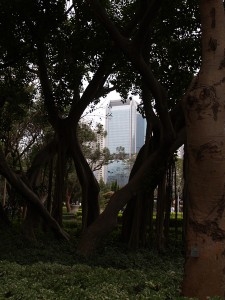
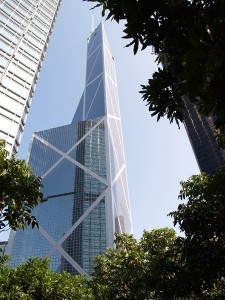
Something cool I’ve noticed while visiting my father, a professor here, is the number of parks and how people in Hong Kong make an effort to make things GREEN.
January 29, 2012 画像13
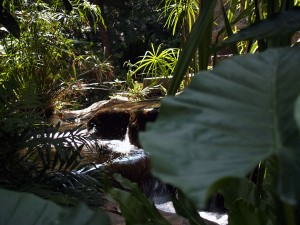
I’m fascinated by the number of parks, planted trees, potted trees, and grassy sitting areas that Hong Kong spreads everywhere to bring a little bit of nature back into a very busy city.
January 29, 2012 画像14
January 29, 2012 画像15

January 29, 2012 画像16
On to Victoria Peak…
Kaitlyn Seay has just finished an internship at Wild River Review and has graduated to become Editorial Assistant.
January 19, 2010
Producing PELTIER:Traveling with Kevin Costner in Indian Country
Filed under: WRR@LARGE — Tags: Kevin Costner, Lakota, Paul Soderman, peace pipe, Tatanka, White Bufallo Woman, Wild River Review, wildriverreview.com, WRR@Large — joystocke @ 10:07 am
Producing PELTIER:
Traveling with Kevin Costner in Indian Country
by Paul Soderman

January 29, 2012 画像17
White Buffalo Calf Woman, Pte San Wi
(Editor’s Note: This is the fourth in an ongoing series. To read earlier installments, click here: Producing Peltier.)
As we traveled across the desolate October plains of South Dakota with Kevin Costner, heading toward Green Grass, SD., the Mecca of Lakota Spirituality, on the Cheyenne River Reservation, I reviewed the purpose of this journey. The plan was to introduce Kevin to Mr. Arvol Looking Horse and take him into his first Inipi, (sweatlodge ceremony). This would also be an opportunity for Kevin to speak about his intentions to the Elders, that he wanted to build “Tatanka”, a cultural center on his land in the Black Hills, near the gambling town of Deadwood, SD.
Seeking cultural and spiritual support for such an undertaking was a humble and honorable act and has reinforced a great respect for Kevin in the hearts of the people. As we stepped out of the vehicle after a three hour trek, he confided in me, “I didn’t know that we were going so far out here’ “Welcome to Indian Country” I said, “where going anywhere is a long journey”.
I briefly shared with him the Lakota story of Pte San Wi, “White Buffalo Calf Woman”.
I had heard the story told many times in ceremony and now we were standing in that place, where the Original Pipe brought to the Lakota two thousand years ago, was still kept.
It is told that at that time a beautiful young Indian woman brought the first pipe to the Lakota People, along with the seven sacred ceremonies, including the Sweat Lodge and the Wiwang Wachipi, (the Sun Dance). They have been practicing these ceremonies since.
For many years, the ceremonies were done only in secret. The US government proclaimed Lakota ceremoniesillegal in the late 1800’s and finally, tenuously lifted that restriction in 1978 when the “Religious Freedom Act” was passed, allowing members of an unrelated religion to practice their ways. The Native Americans rode on the tail of that decision to revive their decimated spiritual culture. Since then, Leonard Peltier and his Native brothers have been, at times, allowed to practice these ceremonies behind bars, which we believe is what has given him the strength to endure the last 34+ years of imprisonment.
Today, praying with a Pipe is most sacred to the Lakota and one must earn the right to become a pipe carrier. It can be likened to joining the priesthood. All pipes are related descendants of the first pipe in Green Grass. In a National Monument in southwestern Minnesota, is a mystical place known as the Pipestone Quarry which is the solitary home of the soft red stone, also know as Catlinite. I have had the privilege to journey to that amazing place twice in my life. http://www.nps.gov/pipe/index.htm
Despite various misconceptions about “Peace Pipes”, traditional Indian tobacco is taken in the dead of winter, from the inner bark of the Red Willow bush, a distant relative of the Dogwood tree. It’s taste is sweet and light and contains no mind altering substance. Nicotine free as well.
After the ceremony and traditional meal, Mr. Looking Horse offered to allow us into the “Pipe House” where the “Chanupa Wakan”, the Original Sacred Pipe is wrapped in a Buffalo hide and suspended from a wooden tripod. As I stood in the close presence of the sacred bundle, about the size of a small child, I could physically feel its mysterious raw power. It seemed to send out vibrations of pure love. My mind, usually a playground of simultaneous thoughts was rendered completely blank. I stood still in reverent silence.
That fleeting moment of my life may translate better in the spirit world, yet I believe that all things happen for a reason. The true meaning of that experience revealed itself, ten years later.
The rest of our sojourn with Kevin was informative and intriguing as we first stopped at the local gas station, 11PM Saturday night, Eagle Butte, SD. We entered the convenience store to load up on all-things-hydrating. As the word evidently spread quickly about who was in town, car lights suddenly appeared from all directions. I was impressed to see Kevin make sure that every hand was shook, every autograph was signed and every picture was snapped, before we headed into the prairie night, back to Rapid City.
The next day we traveled to his Black Hills land, met his parents and talked about Dances With Wolves and baseball, again waiting as the requests for photos and autographs were endless. No one was denied. Exhausting work if you ask me.

January 29, 2012 画像18
Cathie & Paul Soderman with Kevin Costner at the opening of “Tatanka”
Over the next few years, Kevin built his cultural center and we helped when asked to facilitate cultural protocol or ceremony for him. http://www.storyofthebison.com/
We were guests at his stunningly beautiful property in Aspen, Co. and I realized what real movie money could actually buy.
Most recently we had dinner with him here in Boulder, Co. We always learn something about moviemaking in our talks with Kevin and as we told him of our opportunity to make the Peltier movie, he challenged us not to tell the same old “Free Leonard” story. Rather he advised us to, “Find an interesting window to tell his very complex story”. And with our prayers, fortitude and support from many relations, we are now on that journey.
Next…”The Window”
Producing PELTIER is based on the book by Native American Federal prisoner, Leonard Peltier, Prison Writings: My Life Is My Sun Dance. This blog will document their various experiences producing the film, Producing PELTIER. All of these stories are true. Paul currently resides in the foothills outside of Boulder , Colorado with his Wife Cathie and their beloved Golden Retriever, Auggie.
WEBSITE: http://web.mac.com/warriorartist
To support WRR’s mission, and our commitment to support artists and good storytelling, please make a tax-deductible donation by clicking here: Wild River Donation.
January 21, 2010
To: Sean Hannity Re: Dr. King’s Legacy
Filed under: WRR@LARGE — Tags: Don Franco, Dr. King, FAMDO, martin luther king, sean hannity, Wildriverreview, WRR@Large — joystocke @ 5:34 pm
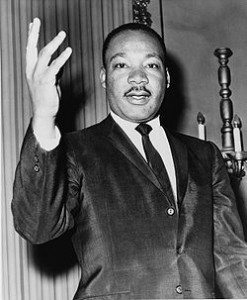
January 29, 2012 画像19
by Don Franco
Dear Mr. Hannity:
Being a man who understands the power of vision, I know how important it is to leave a clear legacy in order for future generations to benefit. And with all your media success, I am sure you would like to leave your legacy intact whenever your time is completed here on our Creator’s earth.
With that, I believe your view of Dr. King’s legacy is seriously distorted. I would even say that you’re close to mocking Dr. King’s legacy as it pertains to a highlight from his I Have a Dream speech. So let’s discuss.
As I seek to understand the issues facing our country, I sporadically listen to your radio show. Over the past two years, I’ve heard African-Americans speak to you regarding race, as well as the inequality that still exists in our country. While speaking with these callers, you typically ask two questions and then hurry to a statement made by Dr. King during his most listened-to speech. These two questions are: “Do you like Dr. Martin Luther King, Jr.?” and “Do you agree with him that we should be ‘judged by the content of character and not by the color of skin?’”
Following these two questions, you routinely state: “I agree with Dr. King that we should be judged by the content of character and not by color of skin.” However, Mr. Hannity, not once have you informed your listeners about the gross inequality that remains among African-Americans here in this country. And by the way, here are a few:
1- Currently, some African Americans, especially young males, are experiencing unemployment rates that are 50% or greater
2- The median net worth—including home values—for blacks is ten times less than for whites ($6,100 vs. $67,000)
3- African Americans make up 13% of the population, yet represent nearly 50% of prisoners in U.S. prisons
4- African-American media ownership is practically non-existent in this country
5- African-American businesses account for just four-tenths of one percent of this country’s total business revenues
My goal of this letter is to publicly acknowledge the official legacy of Dr. King for you, your listeners, and others.
When Dr. King gave his I Have a Dream speech on August 28, 1963, undoubtedly it was a moving speech for most that heard it that day. Additionally, for those of us able to read/hear/see it years later, it still offers great insight into one of the greatest servants (if not the greatest servant) this country has ever produced. Now, I could mention many statements and positions from this speech alone that would discredit your belief that thecontent of character component is the focus of Dr. King’s legacy, but for the sake of time, I have included the speech for you to view at your convenience.
Now, let’s look elsewhere to reveal Dr. King’s true legacy.
On April 3, 1968, Dr. King emphatically focused on economic issues in his I’ve Been to the Mountaintopspeech. Also, it was five years that passed between his “dream-speech” on the steps of the Lincoln Memorial in Washington, D.C., to his “mountaintop speech” at a Masonic Temple in Memphis, Tennessee. I think most would agree that Dr. King became a more enlightened leader and was well aware of how African Americans needed to establish a stronger economic base, even after the passing of the Civil Rights Act of 1964. This stronger economic base is cited by many discerning Americans as the true legacy of Dr. King. With that, take a look at the following statements that were made the night before he was assassinated:
1- “…It’s all right to talk about ‘long white robes over yonder,’ in all of its symbolism. But ultimately people want some suits and dresses and shoes to wear down here…God has commanded us to be concerned about the slums down here, and his children who can’t eat three square meals a day…”
2- “…Now the other thing we’ll have to do is this: Always anchor our external direct action with the power of economic withdrawal. Now, we are poor people, individually, we are poor when you compare us with white society in America. We are poor. Never stop and forget that collectively, that means all of us together, collectively we are richer than all the nations in the world, with the exception of nine. Did you ever think about that?…the Negro collectively is richer than most nations of the world. We have an annual income of more than thirty billion dollars a year…Did you know that? That’s power right there, if we know how to pool it…”
3- “…But not only that, we’ve got to strengthen black institutions. I call upon you to take your money out of the banks downtown and deposit your money in …”
4- “…(through boycotts) we must kind of redistribute the pain. We are choosing these companies because they haven’t been fair in their hiring policies…”
5- “…Now these are some practical things we can do. We begin the process of building a greater economic base. And at the same time, we are putting pressure where it really hurts. I ask you to follow through here….”
So Mr. Hannity, there it is. A stronger economic base is the last thing Dr. King spoke of in his final hours, and it will be beneficial to your listeners if you do your due diligence of the “mountaintop speech.” That way you can inform them of Dr. King’s true legacy.
Sincerely,
Don M. Franco
Founder, CEO
FAMDO, Inc.
Don is the author of the book, “The FAMDO Way: A Commentary and Solution to the African-American Crisis.” You may visit our website at: www.famdo.com or, join FAMDO’s Facebook Fan Page at:
http://www.facebook.com/home.php?#/pages/FAMDO/164257576530?ref=mf
To view Dr. King’s speeches in their entirety, please click on the following links:
“I Have a Dream” http://www.mlkonline.net/dream.html
“I’ve Been to the Mountain Top” http://www.mlkonline.net/promised.html

January 29, 2012 画像20
Don Franco is, in many ways, an American success story. The product of a broken family, he was raised in the type of impoverishment that hinders and destroys the promise of so many potentially productive African-American youth. Yet, instead of becoming another casualty of the inner city, Don overcame to become a college graduate, a successful businessman and a happily married man for the past 24 years.
Don Franco is the Founder and CEO of www.famdo.com a social-entrepreneurial company designed to empower local African-American communities. Don is also the author of the company’s book, “The FAMDO Way: A Commentary and Solution to the African-American Crisis.”
To support WRR’s mission, and our commitment to support artists and good storytelling, please make a tax-deductible donation by clicking here:Wild River Donation.
Comments Off
February 1, 2010
How To Treat an Italian Window
Filed under: WRR@LARGE — Tags: Cornelius Celsus, E. M. Forster, Gregory Blanche, Michael Strassfeld, Terrence Cheromcka, wildriverreview.com, WRR@Large, www.weather.com, www.wikipedia.com — joystocke @ 7:18 am
January 29, 2012 画像21
Light gives of itself freely, filling all available space. It does not seek anything in return; it asks not whether you are friend or foe. It gives of itself and is not thereby diminished – Michel Strassfeld
On of the first things I learned upon arriving here in Italy is that electricity is very expensive. As of 2009 Italy has the second highest electricity tariff in the world, behind Denmark- 37.23 US cents per one kiloWatt hour. In the United States the tariff is 9.28kWh.
In Italy there seems to be an acute level of appreciation for the window; almost every window you pass is beautiful and unique. Instead of a thermometer, the window controls the temperature. During the day, the shutters are opened to let in light and warmth.
As the evening chill sets in, before stove-top espresso and sweet bread, I prepare the windows for the evening turnover ritual – closing the shutters.
The creaking matches the word that my upper-body must do to lock the shutters, not with a key and its hidden processes, but with my own strength and a noticeable rotation of rods and handles. I must also, then, shut the glass windows, move the curtains, and finally slide the inside shutters closed. All of this to keep warm by keeping the cold, out.
Live in rooms full of light. ~Cornelius Celsus
This is a convenient chance to check the weather and is a lot more reliable than Weather.com. And when I open the shutters in the morning, I can’t help thinking, what a beneficial morning stretch! My shoulders open up as I hang out of my window and reach over to unhook the outer shutters.
January 29, 2012 画像22
My “Room with a View” in Florence, Italy
On a beautiful day, I have seen laundry hanging in rooms near the open windows through which the Italian people welcome fresh day-time air into their homes. I can see it drying on racks probably after being washed by hand. I can’t help but compare this process to the New York City laundry day on which I throw a few coins (earned days before doing who knows what) into a machine and then forget all about it and walk away. I have yet to see a Florentine laundromat! It is no wonder careful fashion is well-appreciated here.
So, if understanding the language is the gateway to a culture, the inanimate objects, like the Italian windows, are the handle.

January 29, 2012 画像23
Terrence Cheromcka, 20, has been part of Wild River Review’s staff for two years. She is currently studying Religious Studies in Florence Italy through New York University’s campus abroad.
To support WRR’s mission, and our commitment to support artists and good storytelling, please make a tax-deductible donation by clicking here: Wild River Donation.
January 28, 2010
Listening to Schumann’s Piano Concerto
Filed under: WRR@LARGE — joystocke @ 10:51 am
by Dzvinia Orlowsky
That we don’t all die in childhood
is the greater miracle,
God lifting His light hand
to bring out a phrase, clearing the pedal.
We wear our jewels for the afternoon,
startle birds with the immensity
of our human shadows.
We’ve made it to hard chairs.
Restlessly our hands roll program notes
into telescopes; we intercept genius
with our signature cough.
But what is to be known of great music
other than it requires black polished shoes
and silence,
the incontestable desire to sleep?
See how our mouths relax into soft wax,
our faces drip down our throats.
This is what it must feel like to be lovingly held.
Hear how beauty begs forgiveness
for not including us.
DZVINIA ORLOWSKY is a founding editor of Four Way Book and the author of three poetry collections including “Except for One Obscene Brushstroke” (Carnegie Mellon University Press, 2004). Her poetry and translations have appeared in numerous anthologies including “A Map of Hope: An International Literary Anthology; From Three Worlds: New Writing from the Ukraine”; and “A Hundred Years of Youth: A Bilingual Anthology” of 20th Century Ukrainian Poetry. She currently teaches at the Solstice Low-Residency MFA in Creative Writing Program at Pine Manor College.
Comments Off
February 11, 2010
Nor’easter
Filed under: WRR@LARGE — Tags: Joy E. Stocke, Joy Stocke, Nor’Easter, Northeast Corridor, Snwomaggedon, Wild River Review, wildriverreview.com — joystocke @ 12:04 pm
Nor’easter
by Joy E. Stocke
“…and there was snow in the sky now, setting in for a regular nor’easter.” Elizabeth Stuart Phelps

January 29, 2012 画像24
There’s something about the word Nor’easter that gets the blood going – ominous, dangerous, and there’s nothing you can do about it. According to the National Weather Service, Nor’easters begin when a low-pressure system forms in the Gulf of Mexico and air is drawn toward the Northeast by the Jet Stream.

January 29, 2012 画像25
Those of us who live in the Northeast Corridor that extends from Washington to Boston, are, in fact, water babies, although we often forget the power of the Atlantic Ocean until we head “down the shore” for our weekly summer vacations.Or, until the counterclockwise flow of air around a low pressure system carries warm moist air to meet cold in a cosmic pas de deux .
We mere mortals can do nothing about it. The storm has its own logic and follows the topography of the East Coast. Enter the weathermen and women who reach into their dictionaries for superlatives – in this case, Snowmageddon – coined when Washington DC was forced to shut its doors. Then Balitmore, Philly, Trenton, New York, Boston. The sky becomes eggshell white, Twitter and Facebook pages light up with messages. And then even those slow down as the wind blows and the snow drifts and drifts and, in spite of ourselves, we slip into a giddy reverie.
In 24 hours, the storm will have reached the Canadian Coast and its peak intensity, swirling toward the Arctic where cold air pushes it south again. It is said that the storm can meander for weeks, and even gather its forces for a second round. (There are reports that the East Coast could have more snow on Monday.)
We East Coast folks are an intense bunch as evidenced by the many emails and Facebook messages I’ve received about macho men and macha women out on the streets with shovels – yes, shovels – snowblowers don’t count. But, underneath it all we tough captains and queens of industry have become sentimental as children. We gather for suppers with friends and begin to create the tall tales we’ll surely share with our grandchildren, we initiate snowball fights and claim bragging rights about who has managed to complete the most amount of work without going to the office.

January 29, 2012 画像26
And secretly, or maybe not so secretly, as long as we are safe and warm, (and there have been reports from friends that they are without power) we wish that this feeling of timelessness might last a little longer.
I surely do, but on that note, I must be going because I have a meeting in Princeton. I’ve also got a little shoveling to do so I can get out of my driveway and claim my own bragging rights: Neither rain, nor sleet, nor slow will keep me from driving straight into a snowbank.
January 29, 2012 画像27
Joy E. Stocke is Editor in Chief of Wild River Review. To support the magazine’s work and its mission please click here: Donate.
February 15, 2010
Florence on a Visa: Dante’s Florence
Filed under: WRR@LARGE — Tags: Carnevale, Dante Alighieri, Florence, Italy, John Freccero, Macintosh, New York University, Piazza Santa Croce, Princeton, Viareggio, William Shakespeare — joystocke @ 4:35 pm
In that part of the young year when the sun
Goes under Aquarius to rinse his beams,
And the long nights already begin to wane
Toward half the day, and when the hoarfrost mimes
The image of her white sister upon the ground–
But only awhile, because her pen, it seems,
Is not sharp long–a peasant who has found
That he is running short of fodder might rise
And go outside and see the fields have turned
To white, and slap his thigh, and back in the house
Pace grumbling here and there like some poor wretch
Who can’t see what to do; and then he goes
Back out, and finds hope back within his reach,
Seeing in how little time the world outside
Has changed its face, and takes to his crook to fetch
His sheep to pasture.
(Inf., XXIV, 1-16)

January 29, 2012 画像28
I wish that I could convey, in words, to you, the look in the eyes of an Italian when I referenced Cantos V of the Inferno. The Inferno is the first part of the three parts ofDante’s La Commedia, or as we who read English would say, The Divine Comedy.
He recited diligently, word for word, the section in Italian. He asked me which specific line was I referring to: I was blown away by his passionate response. I was glad that I had decided to use this piece of poetry as a means of communication; he did not speak much Italian and so I named Cantos V (it was our common ground) to get across the concept of romantic love presented in that section. The response gave face to a deeper understanding of the importance of La Commedia as a work of art and a monument to the deep Italian appreciation of that art.
You see, this semester, in my course strictly on The Divine Comedy, is my first time reading the work. The words move me but I am not intimate with this piece at all: The Comedy is not yet alive in my spirit like it is in the heart of the grounds keeper, Lorenzo, here on campus who I am told will recite with a smile at least a line from the Inferno Cantos V or XXVI every time one sees him.
I am told that the Italian children spend two years in public high school literature classes studying solo The Divine Comedy. “Even the garbage man” has much of it memorized by heart. It is deeply embedded in the spirit of this place, Florence, here in Italy. It is as if Dante’s living exile from Florence has been made eternal.

January 29, 2012 画像29
Once in awhile, when the United States of America pass through my thoughts, I wonder what is the equivalent of The Divine Comedy to the American spirit. An American professor of mine, John Freccero, who is teaching the course on The Comedy half-jokes when he says that it is the US Constitution’s Preamble that is written across the hearts of the Americans like The Comedy is written here. That would be, well, reasonable; so long as we do not find ourselves saying that “Twilight” is the same…
T. S. Eliot once wrote “Dante and Shakespeare divide the world between them, there is no third.” It makes me think of one of the first questions exchanged between students wishing to get to know each other during orientation here at NYU: They often ask whether one uses a “Mac or PC” and the answer seems to be a tell-tale sign. Now I may ask Mrs. MacBeth or Beatrice?
Perhaps there is hope though, for such a divine comedy to fall upon the sorrows of America. By this I make reference to Princeton University’s Dante Project (now in version 2.0) which, intended for instructional purposes, a complete online, paper-free, translation of The Divine Comedy. Feeling lazy? Someone, by way of audio file, will read to you. Feeling curious? There are related lectures available too. I can highly recommend you brush up on your Dante: Refresh the spirit!
Though the course of writing this piece I realized (on a deeper level) that the poem is called THE Divine Comedy. It’s very title asserts itself as the sort of dogma it has become for the Florentines. And in a funny, very appropriate manor, Dante pronounces himself (and I must agree already) as such:
Together there, the splendid school of the lord
Of highest song who like and eagle soars high
Above the others. After they had shared a word
Among themselves, they turned and greeted me
With cordial gestures at which my master smiled,
And far more honor: that fair company
Then made me one among them–so as we traveled
Onward toward the light I made a sixth
Amid such store of wisdom.
January 29, 2012 画像30
Thank you for making me one amongst yours.
Terrence Cheromcka, 20, has been part of Wild River Review’s staff for two years. She is currently studying Religious Studies in Florence, Italy through New York University’s campus abroad where, she is proud to say, they accept the course of Dante’s The Divine Comedy as a religious studies credit.
To support WRR’s mission, and our commitment to support artists and good storytelling, please make a tax-deductible donation by clicking here: Wild River Donation.
March 1, 2010
The Italian After-Life: Something they all must face.
Filed under: WRR@LARGE — Tags: Basilica di Santa Croce, California, Dante Alighieri, Florence, Galileo Galilei, Italy, Joan Didion, John Freccero, Piazza Santa Croce, Piazzale Donatello, Ravenna, The Divine Comedy, www.wikipedia.com — joystocke @ 1:49 am
“Whether or not a corpse is torn apart by coyotes may seem only a sentimental consideration, but of course it is more: one of the promises we make to one another is that we will try to return our casualties, try not to abandon our dead to the coyotes.“
-Joan Didion, Slouching Towards Bethlehem
January 29, 2012 画像31
Not only has Italy rocked my notions of time, patience (I thought I was so patient until I visited the Italian post-office), health, waste, cleanliness, and text-messaging but also, in just one month, life after death! I’m not just talking about what I experience when reading Dante’s Paradiso but I’m talking about burial rituals.
January 29, 2012 画像32
I spoke to a native Florentine about the burial processes. This is what he told me:
- In Italy, a primarily Catholic nation, it is customary that the body be laid out (after a viewing) in a casket and buried in that full-length casket.
- Here is where it gets interesting…after 10-20 years (his estimation) a member of the family must be present when they open up the casket and condense the decomposed remains into a smaller container so to be placed in a less-spacious burial site in order to make room for new members of the cemetery.
- Also, in any given graveyard, a family must–every 50 years or so- renew the lease on the plot of land. When, eventually, this lease runs out and stops being paid-for by the family, the remains are removed from that graveyard and put into a kind-of mass grave.
This process may seem unjust to us Americans who associate “Rest In Peace” with gravestones but for the Italians, it makes sense when you look at the figures:

January 29, 2012 画像33
Now, given these figures and the inevitable fact of death, the strict, time-dependent policies of the Italian cemetery seem necessary. Perhaps, too, the grim but inevitable way that the Italians must face the family-member’s decomposing remains is a healthy component of the mortal soul and is good for the human condition.

January 29, 2012 画像34
Here in Florence it always comes around to Dante, “il Poeta.” In 1321 Dante Alighieri died in Ravenna, Italy at the age of 56 as an exile from the Florence that he knew and loved:
“You shall leave everything you love most:
This is the arrow that the bow of exile
Shoots first. You are to know the bitter taste
of others’ bread, how salty it is, and know
how hard a path it is for one who goes
ascending and descending others’ stairs”
(Paradiso, XVII, 76)
His remains are found in a tomb in Church of San Pier Maggiore, later called San Francesco, in Ravenna, Emilia-Romagna, IT. My Divine Comedy professor tells us that every year, like clock-work, Florence petitions Ravenna and asks, per favore, for Dante’s remains. Every year, like clock-work, Ravenna says no. On a couple of occasions Dante’s tomb in Ravenna has been re-crafted which, I think, marks an timeless, undying respect for him.
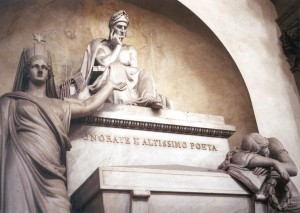
January 29, 2012 画像35
There are many moments whose beauty forbids you from taking a photograph. I circled the Piazzale Donatello graveyard once when it was open in a grave mood, thinking of the mortality of each moment, when I came across a little old woman dressed in fur and a pretty purple hat, sitting a top a tomb-like gravestone, staring off into the car-traffic that passed her by. She was there, I’m sure, thinking of a loved one who had come and gone as quickly as the cars that sped past only a couple of meters away. We exchanged smiles quickly and I hurried off to live the life felt dying.

January 29, 2012 画像36
A joke:
A man walks into a cemetery and is walking around when suddenly he hears Beetohoven’s Symphony No. 5 playing backwards, then his Symphony No. 4, then No. 3. Finally, he finds a cemetery-worker and asks, frantically, where is the music coming from?! The worker turns to him calmly and says: “It is Beethoven: He is decomposing.”
But this is not a joke:

January 29, 2012 画像37
Terrence Cheromcka, 20, has been part of Wild River Review’s staff for two years. She is currently studying Religious Studies in Florence Italy through New York University’s campus abroad.
To support WRR’s mission, and our commitment to support artists and good storytelling, please make a tax-deductible donation by clicking here: Wild River Donation.
March 14, 2010
The Philadelphia Flower Show Underground: 2010
Filed under: WRR@LARGE — Tags: Elizabeth Bako, MODA, Philadelphia Flower Show, Wild River Reivew, WRR@Large, www.wildriverreview.com — joystocke @ 8:51 pm
by Elizabeth Bako
(Editor’s Note: Philadelphia gave birth to America’s first horticultural society, The Pennsylvania Horticultural Society, in 1827 and the nation’s first flower show, the Philadelphia Flower Show, in 1829. Elizabeth Bako went behind the scenes for the 183rd annual Flower Show to get the story behind the story.)
By Elizabeth Bako
Thursday Afternoon: Pre-Show Setup
When I entered the Philadelphia Convention Center on the second to last day of setup before the opening of the Philadelphia International Flower Show, cranes and plows groaned their way around through the cavernous space. Alert to the echoing beeps of machinery in reverse and hopping over jagged piles of lumber, I made my way into the throng, the air just above freezing as a frigid wind came through the open loading docks.

January 29, 2012 画像38

January 29, 2012 画像39
At the entrance, I was met with an enormous life-sized hot air balloon, designed to look like a map of the world. A woman sat playfully posing at the base of the balloon. She introduced herself as Barbara King of Valley Forge Flowers in Wayne, PA and she pointed out that this was the fourth year she has been asked to help create the centerpiece at the entrance of the show.

January 29, 2012 画像40
“We did the flowers for the balloon,” she smiled, pointing above her head. Taking a second look up and to my shock, I saw what I had overlooked before: the balloon was composed entirely of freeze-dried roses and posies, and she and her 80,000 cut flowers could not have looked more welcoming.
She ushered me over to Sam Lemheney, the Director of Show Design who casually informed me that it took over one week and ten volunteers to build the 28-foot balloon.
It is this kind of cooperative ingenuity which has been a trademark of the Philadelphia Flower Show, the largest indoor flower show in the world. Not surprisingly, every show takes eighteen months to coordinate and next year’s show, “Paris in Springtime”, has been in the works since September, 2009.
In a nod to globalization and the fact that many of the plants in this year’s show came from other parts of the world, The Philadelphia Flower Show this year added ‘International’ to its title, and so the theme is, “Passport To The World.”
Sam explained that each plant displayed in the centerpiece exhibit, has been introduced to the area through the flower show, and fostered by a local horticulture center, such as Longwood Gardens.

January 29, 2012 画像41
The proceeds from the show support The Pennsylvania Horticultural Society and its acclaimed urban greening program, Philadelphia Green, sponsoring community gardens and parks where they are needed the most.
After thanking Sam for his hospitality, I set off amongst the piles of mulch and packaging paper to explore the works in progress.
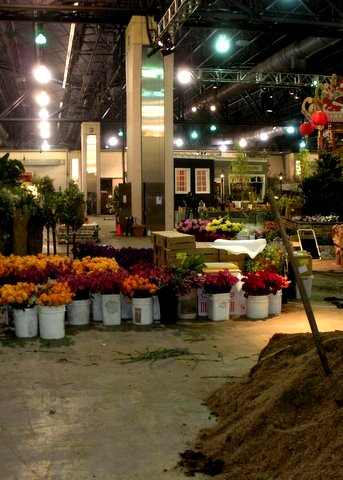
January 29, 2012 画像42

January 29, 2012 画像43
Some of the more notable exhibits included a life-sized elephant made of flowers in the, Flowers! The Jewels of an Indian Wedding exhibit by Jamie Rothstein Distinctive Floral Designs Inc.
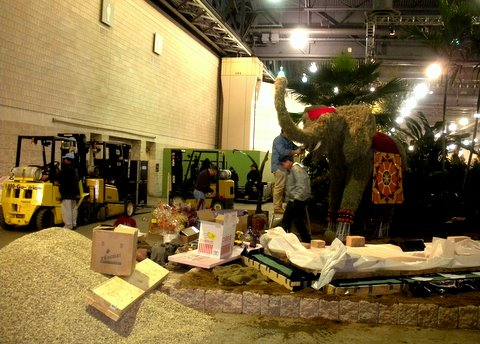
January 29, 2012 画像44

January 29, 2012 画像45
One interesting exhibit, Polar Fantasy, by Scaffer Designs interpreted with floral arrangements and fibre optics on Aurora Borealis.

January 29, 2012 画像46

January 29, 2012 画像47
Thai Tranquility, a Thai tea house sat among smaller spirit houses of the Buddhist culture, on the edge of a lagoon. This exhibit was created by the Men’s Garden Club of Philadelphia, a group of fellows that were quick to pose for pictures between telling jokes, some of them aimed good-naturedly at Stan Amey, their ‘President For Life’. This is their 21st year at the show and their fourth year as a central, non-competitive piece in the show’s theme.
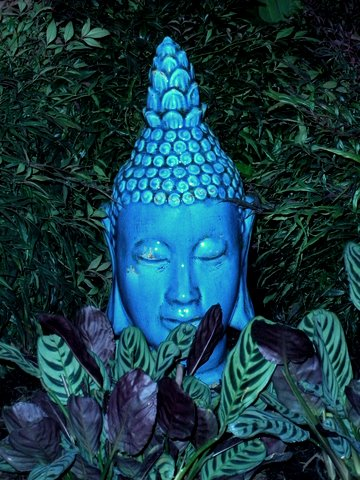
January 29, 2012 画像48

January 29, 2012 画像49
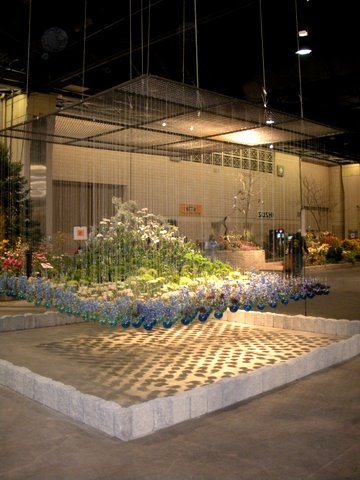
January 29, 2012 画像50
Yet, of all of the exhibits, one that fascinated me most was MODA botanica’s, Box. From across the room I spottedsix shipping containers towering over grass huts, wooden gazebos, and room installation exhibits scattered below it. At first sight it was jarring, out of place, and I had to see it up close.
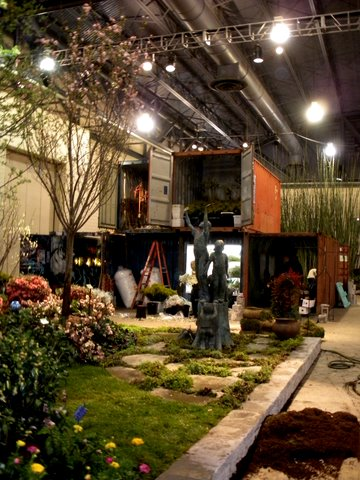
January 29, 2012 画像51
I made my way over to the artists at work on this beautiful monster and was fortunate enough to interview one of the three partners in MODA, Bailey Hale. In show full of country-specific themes, Box sat ambiguously on the side.

January 29, 2012 画像52
MODA botanica’s designs use flowers from all over the world, and they didn’t want to limit themselves. To express the passport theme, MODA employed used shipping containers made in different countries, delivered from a shipping yard in Camden, NJ by semi-trailers two at a time, and then lifted into the second story room by forklifts.
“It could be very harrowing,” Bailey laughed.
The idea, Bailey explained, is to exhibit not flowers but their style, self-described as, “a modern design aesthetic with an artistic approach,” with, “exceptional flowers, creative design and unexpected materials.”
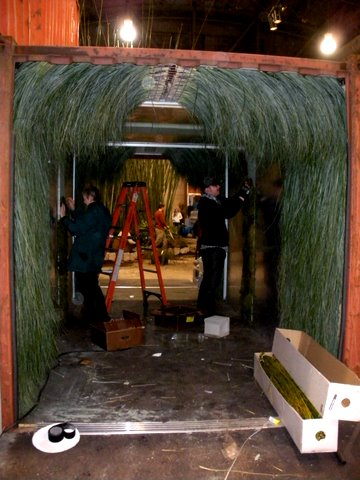
January 29, 2012 画像53
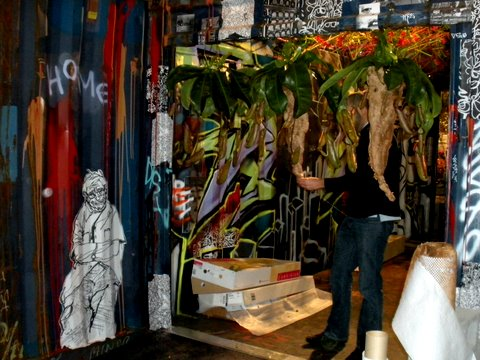
January 29, 2012 画像54
“Flowers by their very nature are pretty,” Bailey said to me as we walked through the containers. “They don’t need our help. We like to challenge people to see things in a new light. Present them in a way you’re not used to seeing.”
Awe-struck at the task Bailey and his crew had ahead of them, I left the show wondering if the exhibitors would ever be ready on time. While I slept Friday night, I learned that the Bailey and his partners, and the design technicians that worked on Box labored away until two am Saturday morning, only to return, fully dressed and functioning, eight hours later. I was there too, eager to see how Box turned out.
Saturday Morning: Press and Judges Only

January 29, 2012 画像55
The opening weekend of the Flower Show brought Philadelphia its fourth major snowstorm. This year, the weather has been brutal, exacting in its ability to shut the city down every week with one storm’s snow piled on the last. The days are short and dim. The moments you steal outdoors in the fleeting daylight are spent huddled face-down, dogged by the biting wind and chill that rushes you from one indoor corner to another.
The cold darkness was spreading and I began to feel as though it had infected my mind. A sort-of dim vagueness had impaired my ability to think and create, and I felt an ever growing urge to give in to the warm-tingly feeling and go to sleep. Saturday, however, I was up early.
When I stood in the open, unpopulated quiet of the Philadelphia International Flower Show’s pre-show, the exposed architecture of the PA Convention Center’s massive ceiling space mirrored in the dark shine of the freshly washed cement floor, and looked up through the beam of a halogen spotlight onto MODA Botanica’s exhibit. At that moment my winter fell to its knees.
My first reaction was to laugh, not because it was funny but because it was my body’s way of dealing with something that I had to first grasp with my mind. The feat was incredible. The art was like fresh water. Six gigantic, heavy-metal shipping containers, two stacked on top of four, posed five rooms of art displaying interactive botanical design and floral show-pieces in a in a way that mingled punk rock with museum-quality beauty.
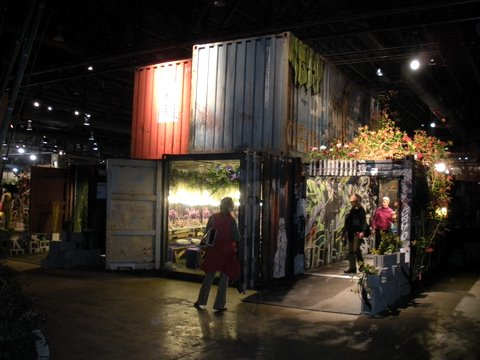
January 29, 2012 画像56
In the few hours during the pre-show, circulated by the press, volunteers and judges, MODA’s exhibit drew a crowd. One woman gaped, “It’s like a wonderland…” as she passed through the exposed light bulbs, reflected into infinity, in the chartreuse-fauna interior of the mirrored shipping crate. Another woman stared, sighing over and over again.

January 29, 2012 画像57
I had to kneel to fully grasp the attention to detail carried down to the flower arrangements, which stood in sophisticated splendor from the cinder blocks on the floor, or peered up at the grotesque display of carnivorous plants hanging from above. The nature and beauty, creation and innovation of MODA’s exhibit reminded me on this miserable winter day what it means to be in a living world.

January 29, 2012 画像58
Two graffiti artists, who write under the names of Distort and Distraught unleashed their art on an open container that created one of the two through-ways in the piece. Intermingled with the graffiti were colorful orchids, camouflaged as if grown there organically, protected by some natural surrounding.
On the container’s side was a series of graphic illustrations of Jane Pepper, is a fine tribute to her last active year as President of the Horticultural Society.

January 29, 2012 画像59

January 29, 2012 画像60
A wildly intricate architectural ensemble of colorful Jute twigs (a plant whose fibres are used to make fabrics) wrapped itself around the graffitied container, hanging precariously off its side and leading to the mirrored show-case, a room cut out and roped off from within one of the container building blocks.

January 29, 2012 画像61
In this container, a dining scene set off by elaborate cut flower arrangements, all in hues of purple, reminded MODA’s audience that their young genius is, of course for hire.
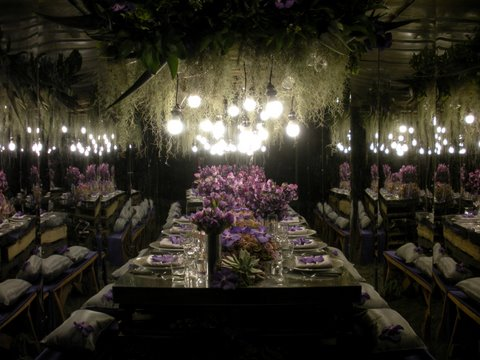
January 29, 2012 画像62
No doubt, MODA’s brilliance was the talk of the show and each angle or turn brought about something new to look at. However, it was at the foot of their Ship Wreck Room where the entire show came to a respectful pause, bowing to the beauty of luminescent white radiating from delicate baby’s breath and fleshy orchids, planted in a dark, rusted, well-traveled container.
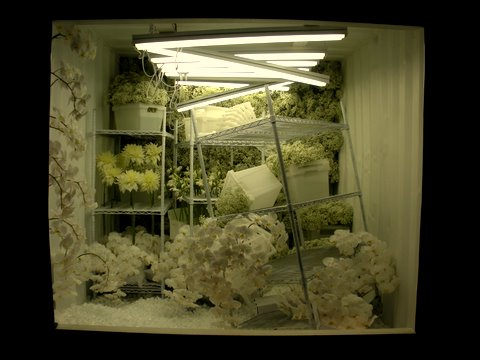
January 29, 2012 画像63

January 29, 2012 画像64

January 29, 2012 画像65

January 29, 2012 画像66
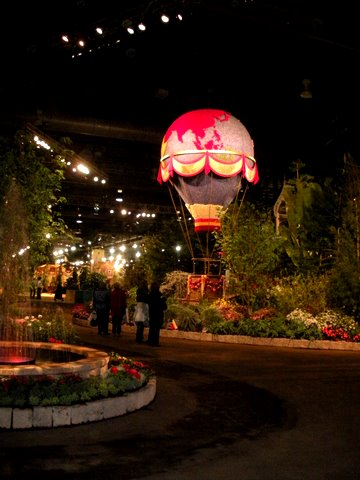
January 29, 2012 画像67

January 29, 2012 画像68
Elizabeth Bako lives in Center City, Philadelphia. She graduated from Temple University after studying abroad in Rome for a year. She has a background in sales and marketing, is a contributing editor for the Wild River Review, and has just finished her first novel.
all photographs copyright held: Wild River Review
You can support our work on Wild River Review, and Wild Table by making a donation: Wild River Review, PO Box 53, Stockton, NJ 08559. Wild River Review is an international website and 501c3 non-profit organization so your donation may be tax deductible.
Please put Wild Bite in the subject line. Thank you!
EMAIL: libbybako@gmail.com
FACEBOOK: www.facebook.com/libbybako
TWITTER: WildRiverLibby
April 1, 2010
Tulips
Filed under: WRR@LARGE — Tags: Dzvinia Orlofsky, Tulips, Wild River Review, wildriverreview.com, WRR@Large — joystocke @ 8:13 am
Tulips
by Dzvinia Orlofsky
What good is love?
My mother’s hand shakes
as she offers it to me
for a goodnight kiss.
I know only hunger,
the wind between my ribs
that will not add weight,
the scales frozen;
heavenly body meant
for someone else.
She whispers: Ja Tebe Lybly.
I love you
into the phone
knowing an ocean heaves
between us, our blood
breathes daughter
mirrored into sister,
Father invisible,
calming the curtain;
proof he lives.
Each morning the vase
next to her mother’s bed
darkens water into earth.
No one will find them there —
What is your favorite memory, Mother?
I can not paint it.
What is your favorite flower?
Two lips in the dark.
January 29, 2012 画像69
Dzvinia Orlowsky is a founding editor of Four Way Books and the author of three poetry collections including “Except for One Obscene Brushstroke” (Carnegie Mellon University Press, 2004). Her poetry and translations have appeared in numerous anthologies including “A Map of Hope: An International Literary Anthology; From Three Worlds: New Writing from the Ukraine”; and “A Hundred Years of Youth: A Bilingual Anthology” of 20th Century Ukrainian Poetry. She currently teaches at the Solstice Low-Residency MFA in Creative Writing Program at Pine Manor College.
April 5, 2010
WHAT’S SHAKING?
Filed under: WRR@LARGE — Tags: earthquake, san diego — joystocke @ 1:23 pm
by Angie Brenner
News Flash:
7.2 earthquake shook Baja and Southern California yesterday, Easter Sunday, around 3:40pm. The same magnitude of quake that destroyed Haiti left two persons dead in Mexico.
Everyone in San Diego felt the quake, but little or no damage was reported – building codes do mean something. Authorities did close the airport for a nano-second, and the nearby Sheraton Hotel empted their top two floors – the harbor land-strip location of these two structures is landfill. (When are they going to move this airport anyway?!)
I live in rural San Diego about an hour’s drive north of the Mexican border town of Tecate, a stone’s throw from the epicenter, more or less. It was one of those amazing spring days in the backcountry, perfect for driving out on Highway 79 past Warner Springs to sketch and watercolor the abundant yellow wildflowers.

January 29, 2012 画像70
Upon arriving home, I grabbed my dog’s lease to take him for a walk, and first heard the loud rumble before the creaking and rattle of windows. Earthquake! Was my first thought and yelled at my dog to hurry and go outside. I quickly calculated how much time it might take for the high wooden beams to come crashing down upon us. “Walk Sam, walk,” I said shaking the lease, but he only stared at me with a look of confusion.
Aren’t animals supposed to sense natural disasters seconds before they happen? Sam wondered why I was yelling. He froze. The rumble turned to a grinding sound, giant granite rocks deep below my feet rubbing against each other. By the time I got Sam out of the house, it was over.
A half an hour later, while describing the event to a friend a hundred miles away who had felt the quake, another, smaller rumble like a freight train rushing past the house, and shake hastened me outside. Sam, who was by then aware of my odd behavior, followed.
Comments Off
April 14, 2010
The New Journalism? What is It?
Filed under: WRR@LARGE — Tags: New Journalism, Warren Bobrow, Wild River Review, wildriverreview.com, WRR@Large — joystocke @ 9:43 am
Editor’s Note: The following email was sent to our Wild Table Editor, Warren Bobrow. It speaks to our mission to publish thoughtful, edited pieces. As we enter our fifth year, we hereby launch, The Slow Web Movement:
“I’ve been in journalism for more than 30 years, all my working life and so have been swept up in the devaluation of the American press and all the effects both cultural and personal.
I’ve seen Newsweek,the magazine where I used to be a copy and layout editor, become a shadow of its former self, and I’m seeing most newspapers stumble all over themselves trying to stay viable on the Internet.
Don’t get me wrong, I’m all for the digitalization of the media and for an oldster (over 50), I’ve embraced it and kept up pretty well.
When I was still an editor, I was the first person at the Courier News, to start shooting videos,human interest, feature videos, as did others, but at the time there was no audience for them.
They were presented properly on our site, but apparently the only videos that get big numbers are crimes and disasters. To that end, The New York Times, which invested millions in their online technology, is the only major newspaper with a decent multimedia interface.
Because the corporate masters are trying to straddle both the print and Web platforms without doling out anything more resources, staffers like me are being worked to the bone as our bosses demand variations of product on our blogs, on Twitter, in photo galleries – and all the while we must still maintain a volume of feature-length stories for print as well!
And editorial standards for the print stories remain more exacting than the loose, first-person, more colloquial reports that are the norm for blogs.
Any single one of these efforts could occupy a staffer full-time, but we’re expected to do it all, with daily and weekly deadlines, and I’m seeing my colleagues burn out around me, as am I. However, even if there weren’t a recession, I’m a single mother with a son about to enter college, so I won’t be taking it easy any time soon!
I think you’re very talented, with a great photographic eye and you pick up on good details for stories — but for your purposes, what I think doesn’t matter, now that I’m a reporter too, not a Gannett editor.
First, they did away with the locally zoned community life sections I was editing, then when I was editing and laying out the editorial pages, they regionalized that and switched from the only paginating software that I knew… so I would have been out on the street with the other 90,000 Gannett Inc. employees who were ousted in the past couple of years if I hadn’t developed cred with my bosses and proved my knowledge of and interest in my specific area of interest, the food world, to them…
Name withheld by request.
Joy E. Stocke is Editor in Chief of Wild River Review.
Warren Bobrow created the Wild Table Blog.
To support our mission, please consider making a donation.
April 20, 2010
No Wine Served Before Its Time…and the Time is Now – Part I
Filed under: WRR@LARGE — Tags: Angie Brenner, California wines, Paso Robles, Tobin James Cellars — joystocke @ 11:02 am
No Wine Served Before Its Time…and the Time is Now
Part I
by Angie Brenner
Over a casual dinner at a friend’s house a few weekends ago, I was introduced to an amazing Cabernet Franc wine. With long legs, hints of berries, smoke, and chocolate, it was a perfect compliment to our early Springstew.
“It’s a Tobin James wine,” said Kristi. “From Paso Robles. Jeff and I are members of the James Gang,” she added, and passed a plate of dark chocolates on a blue Tobin James plate with a spiral sun logo.

January 29, 2012 画像71
“Yummy,” was my unsophisticated response. But it got me thinking about the quality and abundance of the several newer wineries that have sprouted up within California’s central coastal mountain foothills – the now famous ‘wine’ movie, Sideways, was filmed in the area. Since I was already planning a short road trip north of Santa Barbara along California’s Highway 1o1, it seemed reasonable to add a few wineries into the beach mix. Could grapes grown in this agricultural farmland produce wines as good as those from northern California’s high-end wineries in Napa and Sonoma? I wanted to find out.
Day 1 – Unlike Jack and Miles (from Sideways), friend Anne and I are not planning a wild and crazy trip, yet just being out on the open road, zipping through Malibu, the ocean breeze blowing our hair, feels wonderful.
We decide to stay away from the spring-break crowds in Santa Barbara and overnight in the quieter town of Carpenteria, named by explorer Captain Gaspar de Portola for the wooden boats that were made here by the Chumash Indians. Today, it’s a pleasant small, agricultural comunity which boasts “the safest beaches in California.” Along with the deserted beach and sand dunes, there’s an estuary with hovering snowy white Great Egrets.
Day 2 – A long morning beach walk, then we poke our way north on 101 through miles of lush green hills and mountains dotted with California oaks, happy black cows, bright yellow mustard plant and swaths of pale purple wildflowers, the result of a rainy winter. There’s even a field of black, brown, and white lamas – all lying down, facing the north wind.
We stop in the vibrant college town (Cal Poly) of San Luis Obispo with a California mission in the heart of the city, for a cup of Peet’s coffee before continuing north, then east to the Paso Robles wineries – It’s late in the day, but Tobin James is one of the few wineries that stay open past five.
We almost expect to see saloon gals sidling up to the long, heavy wooden bar for a shot of whiskey when walking into Tobin’ s tasting room with its air of the rowdy west. Anne and I squeeze in for a place at the bar along with about ten others, and begin our tasting with a crisp Sauvignon Blanc. Light and nice, nothing special. Then on to the Reserve Chardonnay which is somewhat more interesting, but it’s the reds that I came here for and was disappointed to learn that they aren’t serving their Reserve Cabernet Franc today. But quickly, Terry, a friendly staffer pours a generous sampling of a blended brew from Cabernet, Cabernet Franc, and Merlot grapes called Estate Private Stash. It was very tasty indeed, and one of the pricier selections. Soon Terry and the other Tobin employees, Sarah and Scott, turn the tasting into a party atmosphere. The resident chef saunters in with a plate of appetizers, thin toast layered with melted provolone, tender fillet, and chimichurri. This group likes to have fun and eat well.
The couple standing next to me, Ryan and Lonnie Sims, have just toured Napa wineries and tell me that Tobin’s Ballistic’ Zinfandel is the wineries’ signature wine. ‘Layers ‘n layers of juicy Zin flavors,’ says the tasting list, and it’s true. After sampling a couple other of the “James Gang Reserve” reds with their rich, complexities, I leave with a bottle of the Zin.
January 29, 2012 画像72
We’re happy to head west again across the misty green mountain range – which Anne says looks like her families’ Irish land – to the tiny coast town of Cayucos, north of Morro Bay, to enjoy creamy clam chowder and steamers at Ducky’s, a starlit walk on the pier.
Napa may still rank high with wine connoisseurs but can’t compete with the Pacific Ocean.

January 29, 2012 画像73
Tomorrow we head south to try on the Santa Barbara wineries for size…and taste.
April 28, 2010
OLD PUBLISHING vs. NEW MEDIA ….at the Los Angeles Times Festival of Books
Filed under: WRR@LARGE — Tags: akashic books, Angie Brenner, bonnie nadell, carolyn kellogg, dana goodyear, david grann, george gibson, johnny temple, Los Angeles festival of books, pablo defendini, wil wheaton — joystocke @ 2:06 pm
By Angie Brenner, from the Wild West
January 29, 2012 画像74
For all of you who haven’t attended the L.A. Book Festival, you are missing out on one of the best book events anywhere. This year, marks the 15th anniversary of a festival that drew up to 130,000 people to the sprawling UCLA campus the last weekend in April. Among 400 authors and artists, there were 100 or so author interviews, panel discussions, and entertainment at 18 campus venues, plus hundreds of exhibitors. With so many options to choose from, I was forced to narrow my focus to a couple author interviews and panels.
Two years ago at the festival, the L.A. Times Book Editor and moderator for a panel discussing how book reviewers were being marginalized, said that his newspaper was beginning to look into expanding their Internet coverage.
“Beginning!?” I almost shouted. “What are you waiting for?”
Fast-forward to Sunday’s panel called Inside Publishing, where two literary agents and two publishers shared how their businesses have changed in today’s digital world and slumping economy. Johnny Temple, editor of the independent publisher, Akashic Books, said that along with writing talent, he looks for smart, compassionate, considerate, writers who have the ability to sell books.“We’re a small, sensitive staff who loves our authors.”
The rest of the panel agreed. Literary agent Bonnie Nadell added that, “politeness (from authors) counts.” George Gibson from Walker & Co. (a division of Bloomsbury USA) said that his company is cutting down on areas of publishing, but added that, “they haven’t plunged the depths of the Internet.”
January 29, 2012 画像75
I liked George, especially when he said that if “you write a good book, its going to get published.” He was droll and witty, but did I really believe him? Also, I wonder why these ‘insiders’ aren’t waking up to technology and getting more creative than cutting divisions and limiting the number of books and copy runs. But their talk about the kindness and sensitivity of agents and publishers was sort of sweet. I was touched.
Gibson talked a lot about how much luck is a factor in getting a book published, and his advice to would-be authors was to “write a really good pitch letter and manuscript.” The audience and panel members laughed when he said that to remember (when writing the letter): “friend” is not a verb. The slam to texters was funny. Yet, was he missing the point?
I decided to make my way to Moore Hall to hear what the kids on the New Media Meets Publishing panel had to say.
Right off, I knew this was going to be a completely different discussion. Dana Goodyear, a young writer for the New Yorker and co-founder of Figment – a mobile-based reading and writing Internet site for young adults – said of new writers, “you don’t need to know someone in New York to get published.”
Wow, I wanted to introduce her to George Gibson.
Blogger, Pablo Defendini, chimed in: “Anyone with a computer can get published.”
Soon, it was a free flowing exchange of ideas on e-book publishing with actor, author, blogger Wil Wheaton leading the group discussion about the fear the big six publishers have in stepping into digital books. “The big publishers don’t get it,” he said. “but we’re dragging them into the end of the 20th century.” – A chuckle from the audience – “When we embrace the way people get media, it works.”
January 29, 2012 画像76
Wheaton talked long and funny about the industry’s fears of losing money through posting e-books, suggesting that these aren’t give-aways, but only a different way to publish. “You want to get the work out, not limit it.”
It made me think of how Amazon and Google both spent years without profits and trusted the process. With stockholders and infrastructures to sustain them, the big six are reluctant to move out of ‘dead-tree’ (Wheaton’s term) publishing.
When asked, Wheaton said that if you decide to self-publish, put your money into editing, prompting moderator Carolyn Kellogg, with a titter, suggesting authors hire those editors fired from the newspapers and publishing houses that have scaled down.
Of the big publishers reluctance in moving toward e-books, Defendini said that they “haven’t internalized it yet.” Publishers sell to the bookstores and they usually have only one person doing the buying. “No one is talking to the reader.”
I had just read an article in the current New Yorker: Publish or Perish, where Random House C.E.O. was quoted that he needed to talk to his stakeholders, authors, agents, and booksellers, before deciding to go digital. “They aren’t asking the readers how they are getting information and reading,” said Defendini, using the term: head-desking. I guessed that these people might well consider friend a verb.
Goodyear added that Figment is looking into all the ways digital books can look to please the reader. “Young people don’t mind scanning page to page to read, but with the iPAD, it can look as if they are flipping pages.”
The discussion ended well after the allotted hour . Unlike the previous panel who are still grappling to figure out their market foothold, this group left me lighthearted and hopeful. And like I’d heard in an earlier panel from another New Yorker author, David Grann: Regardless of the format, “there is always a need for a good story, its built into our DNA.”
Angie Brenner is West Coast Editor for Wild River Review. She is the author of the forthcoming memoir Anatolian Days and Nights, A Love Affair with Turkey, Land of Dervishes, Goddesses and Saints.
To support our mission and passion for good storytelling, please make a tax-deductible donation by clicking here: Wild River Donation.
To join our mailing list, enter your email and receive WRR Monthly.
May 17, 2010
No Wine Served Before its Time……and the Time in Now – Part II
Filed under: WRR@LARGE — Tags: Angie Brenner, richard longoria, Santa Barbara wineries — joystocke @ 2:25 pm
By Angie Brenner
(Author’s Note: PART I was posted on WRR@LARGE April 20, 2010)
Day 3 –
Today, after stops to sketch and watercolor Pacific Coast waves at Morro Bay and Abila Beach, we decide to save the many spa opportunities for a later trip (Paso Robles’ hot springs have soothed tired bodies for thousands of years) and head south on Highway 101 toward Santa Barbara’s clusters of wineries.

January 29, 2012 画像77
The quest is to find ZacaMesa, a recommendation from new-found acquaintance, Ryan Sims. “They are known for producing some great Syrahs,” he told us. Once off the highway, we dawdle stopping several times to photograph budding vineyards, swaths of yellow wildflowers, and robust oak groves. Like an omen, a lone eagle sweeps overhead when Anne informs me that we’re almost out of gas. “How far is it to Zaca Mesa?” she asks.
I check the map and tell her that it’s about a half inch. “Maybe ten miles more or less,” I say optimistically. We ponder whether to turn back to the highway to a known gas station or continue on before the winery closes and hope for the best. Easy choice; we arrive with enough time to taste the Syrah. My palate searches to capture ‘hints’ of rich blackberry, cassis, espresso, mocha and Zaca Mesa’s signature sage spice with a silky finish of ripe tannins and smoky oak.
“I can’t taste any of these things,” says Anne, who prefers crisp whites. “It’s tasty, a little heavy, but tasty.” I purchase a bottle of their 2006 Syrah before they lock the doors and we back track to the highway for gas, missing out on one or two wineries we’d hoped to visit on Foxen Canyon Road. Once fully gassed, off we go to the tiny town of Los Olivos – also featured in the movie Sideways – where several wine shops nest together along the main street between trendy restaurants. It is here that we find the antithesis of the Tobin James Winery in Paso Robles.

January 29, 2012 画像78
The quiet, understated tasting room of Richard Longoria suggests equally subtle wines sans any trace of flowery descriptions. “Rick likes people to experience their own tastes, not his,” says the hostess, who then explains in great detail the wine making process from field, soil, harvesting, and fermenting.
“Wow, I’ve learned more in the past ten minutes then anywhere else,” says Anne, taking a second sip of the Longoria Pink Wine. This family-run vintner also produces a smooth Pinot Noir and a blend of Cabernet Franc, Merlot, Syrah, and a straight Cabernet Sauvignon called Blues Cuvee. Each year Richard Longoria honors his love of wine and music by featuring a different blues artist on the label. His annual wine and food event caters to sophisticated connoisseurs featuring the blues artists and elegant food – a far contrast to Tobin James’ cowboy barbecues and Caribbean wine cruises.
As the shops lock their doors for the night, Anne and I drive off – literally into the sunset – enjoying the rosy warmth of evening sun and wine, knowing that we’ve only scratched the surface. And while I have my preferences, I can’t help but enjoy how different winemaker’s personalities (whether a small family or corporation) emerge as each bottle opens.
“Why don’t we grow our own grapes and make our own wine?” suggests Anne. “There’s plenty of land behind your house.”
Humm.
Comments Off
May 28, 2010
New Age
Filed under: WRR@LARGE — Tags: Gulf, Kim Nagy, oil spill, poetry, Wild River Review, wildriverreview.com, WRR@Large, Yoga — joystocke @ 1:22 pm
by Kim Nagy
thoughts on the Gulf Oil Spill during last week’s Yoga Class

January 29, 2012 画像79
copyright New York Daily News
She asks us to spread out
and think
Of the emotions to which we cling
that hold us back.
Bliss …
can you imagine its color
and texture? I think of
my car in the parking lot, the smell
of grass, the trees outside the window. Right now,
she explains, but I forget
how my opened
heart will nest the next
season of swallows How it will offer
blood like oil to my outstretched
hands, to the drilled and torn
ocean
clouds I offer only
the effacement
of my breath. Meanwhile
a man weeps
for a crime he did
not know, he did not
know (who did, who didn’t) a mother chases
her child through
trampled flowers. Innocence is nothing
to awareness
and awareness too small, too wide
too sweeping a word for the parking lot
present. A labyrinth is more
like it! Let us consider the pristine
fountain at the center and its dizzying
unscaled walls…the sacred
question:
is it really
only one act
that might transform
the rest
of our lives?

January 29, 2012 画像80
Kim Nagy is Executive Editor of Wild River Review and author of the column The Triple Goddess Trials. To support our mission and passion for good storytelling, please make a tax-deductible donation by clicking here: Wild River Donation.
June 21, 2010
The Queen of Anatolia
Filed under: WRR@LARGE — Tags: Anatolia, Anatolian Days & Nights, Angie Breener, Angie Brenner, Ankara, Cybele, Ephesus, Joy E. Stocke, The Queen of Anatolia, Turkey, Wild River Review, wildriverreview.com, WRR@Large — joystocke @ 11:51 am
The Queen of Anatolia
by Joy Stocke and Angie Brenner (Excerpted from the Memoir, Anatolian Days & Nights)
“Everything we see in the world is the creative work of women.”
Mustapha Kemal Ataturk, Founder of the Republic of Turkey

January 29, 2012 画像81
Cybele – Mother Goddess of Anatolia (Turkey)
Courtesy of the Anatolian Civilizations Museum, Ankara, Turkey
“An-neh!”
The little girl’s voice vibrates in the chill morning air. In a navy-blue woolen dress and brown tights bunched at her ankles, she tentatively crosses the courtyard, tears shining on her cheeks. “An-neh!”
A woman breaks from a group of mothers standing at the ticket booth. In a storm-grey headscarf and black, double-breasted, ankle-length coat, she hurries toward her daughter scolding her indulgently before scooping her into her arms to kiss away the tears.
The call of a lost child seeking her an-neh, her mother, seems a fitting welcome to Ankara, home of the Anatolian Civilizations Museum, which holds one of the world’s greatest collections of sculpture and art dedicated to the mother goddess. Long before the rise of Judaism, Christianity and Islam people worshipped the Great Mother who had many names: Artemis, Aphrodite, Cybele, Diana. The Greeks named the land now called Turkey, Anatolia, in honor of her incarnation as Anat, goddess of the rising sun. And from that goddess, the word Anne – Mother – entered the Turkish vocabulary.
I have loved the goddess in her incarnation as the Virgin Mary since I was a child and credit my Catholic upbringing for my affection. At Sunday Mass, I often sat in a pew near a niche that contained her statue, her marble body robed in a sea-blue cloak, her rosy-cheeked son Jesus sitting on her lap. While the priest went through the rituals of the Mass, I smiled back at her, because surely the kind and compassionate smile on her face was put there for me.
“I’m so sorry about your son,” I would whisper, trying to imagine what it was like to be told you will bear the son of God and that one day you would watch him nailed to a cross and tortured to death. On the first of May, with the other girls of the parish, I would dressed in white to celebrate her, laying roses on the altar and singing, “Salve Regina, Hail to the Queen.”
Angie’s interest in the mother goddess followed a different path. Raised Protestant by a Catholic mother and Dutch Reform father, Angie asked questions that were never fully answered. For instance, outside of the birth story of Jesus, why was Mary ignored?
When we began traveling to the Mediterranean region, we discovered that Mary has a long line of ancestresses, goddesses who, for good and ill, held sway over the mortals in their midst.

January 29, 2012 画像82
And so, on a morning in May, far from Ankara in Central Turkey, we find ourselves on a shaded hill near the town of Ephesus in front of a Byzantine house made of stone. Tradition says that Meryemanna, Mother Mary, the Blessed Virgin, spent the final years of her life here.
To thousands of pilgrims, it makes no difference that the house was built three centuries after Mary’s death. Or that it wasn’t discovered until the nineteenth century when a bedridden German woman, who had never visited Turkey, saw it in a vision.
Inspired by the German woman’s description of a house constructed of stone blocks with rounded arches, a priest from the nearby port city of Izmir traveled to Ephesus and found an abandoned house nestled in a pine grove overlooking the Aegean Sea. In 1967, Pope John Paul VI canonized the house as the official residence of Virgin Mary, the mother of Jesus, and as her final resting place.
Does it really matter whether the house belonged to the Virgin Mary or not? Muslims as well as Christians make pilgrimages there to honor her. Inside her house, inscriptions from the Q’uran flow across the walls in Arabic calligraphy. Following a tradition stretching back to their nomadic and shamanistic past, Muslim worshippers tie white strips of cloth to a tree near her house so their prayers may be answered.
In 451 CE, the Council of Chalcedon awarded Mary Christianity’s highest honor, the title of Airoparthenos, Ever-Virgin, one who never had intercourse in order to conceive her son.
Her foremothers would have been shocked. In their time, procreation was held as a mystery of greatest importance in the endless cycle of renewal and birth. A goddess could mother hundreds of children and still be called a virgin.
Modernity, however, can be deceptive; and in this case even comforting. In a secular Muslim Republic, Turkish children evoke her name hundreds of thousands of times a day whenever they call for their anne.
January 29, 2012 画像83
House of the Virgin Mary, Ephesus, Turkey, ephesusguide.com
Joy E. Stocke is Editor in Chief of Wild River Review. The essay above is an excerpt from the memoir, Anatolian Days & Nights, A Love Affair with Turkey, co-written with Angie Brenner to be published in 2011.
To support our mission and passion for good storytelling, please make a tax-deductible donation by clicking here: Wild River Donation.
Comments Off
June 28, 2010
“Making a name for Taiwan” is NYU Freshman Joe Lo
Filed under: WRR@LARGE — joystocke @ 1:51 pm

January 29, 2012 画像84
At NYU we call it “word-vomit.” It is a condition that usually suffers an English speaking American who was born with the unlimited freedom of speech. The condition was further spread, perhaps, by the ability to flash communicate, almost magically, with the wave of a text-messaging bond. I thought about “word-vomit” as I reflected upon a talk I had with a Taiwanese NYU freshman, who, for safety reasons we will call “Joe Lo.”
Let me explain. One Italian lesson required each of us students to compose a piece of news in Italian. I imagined a “Divine Comedy” theme park. Joe imagined that Taiwan had declared independence. When he handed the paper to the teacher he seemed shy and explained that it might sound ridiculous to her. I just had to ask…
I have never seen a person my age as thoughtful with his words as Joe. He thought before every statement he made (the perfect politician, I thought). I imagined him threading this feelings and thoughts together carefully behind closed doors. Joe Lo certainly had not caught the word-vomit bug and he might be immune.
Taiwan; The People’s Republic of China; Formosa; “The beautiful island” has been tossed about between the Dutch, rule in China, and Japan. Though it eventually gained political independence Taiwan have never been raised to nationhood independent from China. At one point in history Taiwan cut off communication with China; The two entities are on deeply different pages.
Joe Lo says he has been “sensitive” to the political matters in Taiwan since he was young. When he was in only 8th grade he remembers getting very “fired up” at the time when the Taiwanese government changed party-ties for the first time in fifty years. The boys I knew in 8th grade were getting fired up about me.
I joke. But Joe cannot because to him 8th grade was the time when China had 600 nuclear missiles aimed at his homeland, Taiwan. He didn’t even stop to pause at this statement: I interrupted and asked him if this threat scared him at the time and he said no. He realized no fear even though some years early China had actually succeeded in firing two missiles that landed off the coast of Taiwan? That he was not scared at all bewilders me.
I was a victim of collective girly insecurities while Joe was a victim, while attending boarding school in the US, of intellectual bullying. His friends poked fun at him by walking up to him and asking “Wait, if you are Taiwanese doesn’t that mean you are really Chinese?” And then they would walk away before he could defend his nationality. Joe is Taiwanese but imagine having the integrity of your identity doubted by those lacking understanding of you as a person. “Why should my identity even be questioned?” he said.
After talking to Joe I feel that we take for granted and discount our American identity and our American passport. My friend here in Florence is a $50 flight away from all of magnificent Europe but his Indian passport won’t let him leave Italy. Joe Lo admires that we, as Americans, can stand up and proclaim our nationality without being misunderstood at all. We, as Americans, can even insist on our multi-national roots. I am Polish-American, Scottish-American, British-American but really what am I? But really I am American and I am blessed that I can stake all of those dramatic claims without anyone questioning me like they do when Joe says he is Taiwanese.
Division is even evident on Wikipedia, our little toy. Joe wants to comment on the Wiki-page for the Republic of China but he can’t. He is afraid that the government would trace his comment back to him and he would get in trouble.
Joe’s goodness radiated through his words and I felt sorry: He wasn’t sure if he could be a politician or not. His mother made a beautiful point that, you know, we all have the potential for evil and being involved in politics tends to accentuate that evil. But I felt sorry because I think Joe would be just what Taiwan needs and would be a great politician (Not like the Taiwanese congressmen he told me about who stampeded through court rooms shouting and cursing–perhaps cursing their laundered money). His mother is right but I want for him to prove her wrong–isn’t that a child’s job anyways?
I can’t make sense of this identity crisis but I know how an identity crisis feels. My identity crises usually come from within, though, and I’m sure Joe has those too. In that case, these layers of identity might simultaneously exist in a way that my prideful American soul can’t imagine.
I write because I want people to think when they read what I write–maybe even leap into a new perspective. I want you to think about yourself, in terms of others. When I think about Joe I think about how Generation Y think about ourselves as citizens. With all his careful observations about his political and national identity does he even have time to think of the matters of identity that I think about? Religious identity is no factor in Taiwan’s identity crises but does that mean that “if it isn’t one thing it is the next” and religious questioning is just the next link in the chain of succession of the tug of war with identity and freedom from it’s restraints. Is it inevitable, for the rest of life, that identity will constantly be questioned and challenged? Is it, simply the human condition and is, perhaps, Joe in some way blessed because he can channel his frustrations about identity towards some ranting politicians rather than inwards, towards a suffering self?

January 29, 2012 画像85
Terrence Cheromcka, 20, has been part of Wild River Review’s staff for two years. She is currently studying Religious Studies at New York University.
To support WRR’s mission, and our commitment to support artists and good storytelling, please make a tax-deductible donation by clicking here: Wild River Donation.
July 20, 2010
DISPATCHES – Camp Delhi, Helmand Province
Filed under: WRR@LARGE — Tags: afghanistan, Ashwin Raman, marine corps, michael fay, war — joystocke @ 10:40 am
Michael D. Fay
June 2, 2010: Headquarters 3rd Battalion, 1st Marines
January 29, 2012 画像86
It’s such a simple thing. After fifty plus years you’d think I’d have a handle on it, but I don’t. I can’t tell my right hand from my left. I have to physically make the writing motion to cue myself. I can add another bit of brain malfunctioning to an ever growing list of idiosyncrasies, the word Delhi, or is it Dehli?
While out here I had occasion to meet an Indian Buddhist German documentary film maker, Ashwin Raman. Ash, as he asks to be called, started his documentary film career with the Marines in Vietnam, and now, days away from his 66th birthday, is marking his retirement with a final trip covering them in Afghanistan. I shared my sketches with him and immediately he chided me for my mis-spelling of Delhi on a couple. I got a few right, but on most I didn’t. Even now I have to write it both ways before my brain picks the correct one.
I arrived at Camp Delhi around midnight the night of June 1st on a CH-53 ride from Camp Bastion (or should I say the morning of June 2nd?…no matter). My hosts billeted me in a cave like room with a smokehouse smell and giant cotton candy spider webs in all the corners. Black Widow and Brown Recluse spiders are everywhere here. I got a broom first thing in the morning and reduced the webs to a tangle of fuzz on the bristle ends. Written in the soot covered walls and ceilings are graffiti from both American and British units. Judging by the bullet marks, both inside and out, this place saw heavy fighting. The Brits left a memorial to a bunch of their mates.

January 29, 2012 画像87
Delhi has a shower and I treat myself to one. These are Navy Showers-get wet, turn off water, lather up, turn water back on, rinse. Anything more than a minute’s worth of water is a crime. The weak lukewarm stream of water hardly seems worth the effort. Most Marines use the hygiene pit, a matted area with an open square with football size river rocks at the center, and bordered on two sides by makeshift wash stations. At one corner of the pit is a metal brace with a large flare gun-like spigot attached to an oversize hose running to a large rubber bladder containing non-potable water. Each wash station has a mirror and a circular hole cut in the waist high plywood table that accommodates a stainless steel bowl. Each table has spots for six. The bowls are stacked up at the angle where the tables meet. You’re expected to rinse yours out when finished. Even in this arachnophobes’ worst nightmare of a place there are etiquettes to be followed.
January 29, 2012 画像88
January 29, 2012 画像89
At 0900, after breakfast and some sketching, I meet with the battalion’s adjutant and arrange to get manifested on a convoy down to their Weapons Company at FOB Gorgak. Weapons is the furthest south unit in the hotly contested Helmand River Valley.
January 29, 2012 画像90
The poppy harvest is over and the Taliban is flush with cash. I’m eventually heading to the where the sidewalk ends, Patrol Base Karma. Beyond Karma there is nothing but bad guys. Just last week they lost two Marines to an IED along a canal path. In another incident just days before another guy, though he survived, lost all four limbs to a pressure plate bomb.
I have until 1030, when the convoy brief will be held and my vehicle assignment made. I pack up my gear and stage it by a row of huge tan MTAVs and MRAPs. Other Marines waiting for a ride south mill about while convoy drivers and embark guys with a fork lift fill the back of trucks with supply laden palettes.

January 29, 2012 画像91

January 29, 2012 画像92
January 29, 2012 画像93
A closer look at the vehicles reveals a riot of scrapes, dings, bent bumpers and an undercoating of rock hard mud splatter. They’re as worn and dirty as the Marines sitting against underinflated tires in the shadows, and trying to catch forty winks in crew cabs stuffed with weapons, body armor, bottles of water and cases of MREs. This place is brutal on man and machine.
Off by the main ECP (entry control point) a patrol is forming up to leave the wire. This is a patrol party that virtually no Hollywood film has yet to capture. This is a FET (female engagement team) mission. Four of the Marines adjusting their gear and weapons are female.

January 29, 2012 画像94
There’s a minor statistic that doesn’t get a whole lot of play in the coverage of Afghanistan. In fact, based on my own observations, I would classify this bit of information as little more than a rumor. But the Marine Corps, being what it is, has decided to take this data and run with it. This is the unsubstantiated claim I’m referring to; half the population of Afghanistan is women. The mission of the FET Marines is to reach out to them. Those of us here can tell you there’s a better chance of encountering a Yeti than an Afghan woman. Be that as it may, the Marines have organized and deployed groups of female jarheads to actively meet with and engage them in the political process.
January 29, 2012 画像95
Sergeant Melissa Hernandez is an MP (military police) by trade. Today she commands a FET. She’s as geared up as any Marine I’ve ever seen, along with a team of two other female Marines and a female Navy corpsman. They’re on their way outside the wire to meet with local women. In my humble opinion these women are doing more than the entire National Organization of Women put together.
Comments Off
July 29, 2010
How Many Facebook Friends are Too Many?
Filed under: WRR@LARGE — Tags: celebrities, Desk Jockey, Facebook, friends, New York City, Wild River Review — joystocke @ 11:22 am
by Desk Jockey

January 29, 2012 画像96
I can see it now.
Ten or 12 anonymous individuals pile into a room in the basement of a small church on New York’s Upper East Side. No one glances from side to side. At 8 o’clock sharp, a facilitator—someone who vaguely resembles the young Meg Ryan—walks into the room and welcomes us to “Facebook Friendaholics.”
“Would someone like to start?” She looks around the room. “How about you, in the New Zealand bicycle jersey?”
Desk Jockey always knows he will be the first to get called on. He stands up uncertainly, clears his throat, and begins mumbling, “Hi, I’m Desk Jockey, and I’m a Facebook Friendaholic.” Applause from around the room.
The chance that this will happen, even in Manhattan, a city where there are actual gay Jewish Republicans living on the West Side? Slim to none.
So rather than speculate about what might happen, Desk Jockey will share his descent into the lowly depths of Facebook addiction—in the hope that you, dear Wild River Review readers, may recognize some of your own behavioral patterns, and stop indiscriminate Facebook friending before it’s too late.
2005: A year that will live in infamy
Before Desk Jockey took his current, 24/7/365 position in the widget company, he held another position in the company’s Connecticut office, approximately five years ago. That job involved approximately one-quintillionth of the brain cells he currently expends, so to overcome his relentless boredom, he joined Facebook on the advice of a friend.
Once Desk Jockey signed up, he found Facebook to be an excellent way to start snooping into the private lives of his closest friends and co-workers. At this point, it’s important to note, he kept his circle of Facebook friends to people he actually knew quite well.
That ran out in about five minutes. So to further curb his boredom, Desk Jockey began capturing the addresses contained in long, tedious emails he would receive at work from colleagues. Thus, during dial-in calls and every other conference calls associated with mundane corporate life, Desk Jockey would busily friend associates while his phone was on “mute.”
Living socially. Very socially
While making all these new FB friends, Desk Jockey began to notice that status updates, whereby you announce what you are doing at any particular moment in time, were pretty banal—to the point of “Susie ate a bagel this morning” or “Eva took little Johnny to the community pool.”
Desk Jockey vowed never to stoop to such depths and to populate his status updates only with his forays into the worlds of New York City culture, restaurants, or his quasi-Herculean exercise sessions. (After all, if you can’t work out three hours a day, then dine at a one-star Michelin restaurant, then sit in the orchestra section at the Met afterwards, what’s the point of living in New York City?)
The surge begins, 6,000 miles from Iraq
Fast forward to the summer of 2009, when Desk Jockey began to get somewhat obsessive with his Facebook friending. He believes it happened when he reached Friend #500, an achievement he proudly announced in a Facebook status update (whereupon he was promptly told to get a life by fellow “friends.”) A countervailing theory is that it happened when a friend posed the question one day on the homepage, “How many of your Facebook friends do you really know?”
Desk Jockey responded, in his comment on her question, “All 500 of them.” But then he begin to wonder, do people actually friend people they don’t know?
The answer, he discovered, was yes, people on Facebook do friend perfect strangers. And that’s when the real addiction began.
Mutual friends: the key to building a Facebook empire
When by sheer happenstance, Desk Jockey discovered a perfect stranger with whom he had at least seven friends in common, he friended that person, not even having met him or her.
This is the way you turn 500 friends into 600 friends in one month. And then proceed to grow your FB friend list at the rate of 100 new friends every two weeks. Then 200 new friends every calendar month.
The Facebook Website, Desk Jockey is convinced, is an enabler. Every time you sign into the home page, a little reminder pops up that you have 37 friends in common with a perfect stranger. Rather than be unfriendly (which is not proper FB etiquette), Desk Jockey began clicking “accept.”

January 29, 2012 画像97
Who’s easiest to friend on FB? Actors, Writers, and Politicians
As he began accumulating these strangers-cum-friends, Desk Jockey began aiming for bigger game in his search. (After all, his philosophy of life, as expressed on his home page is “Whoever dies with the most FB friends, wins.”). He began searching the names of actors he would see in movies, on television, or in plays; amazingly, he did have actual friends in common with these people. That was good enough for Desk Jockey, who invited these celebrities to be his friends. Often within seconds, most of these celebrities friended him right back.
(Brief aside: It’s important to note the distinction between becoming a “fan” of such celebrities (a status thousands of people can easily achieve by clicking “fan” on their page) and the elite status of becoming an actual “friend” of these celebrities, even if they wouldn’t know you if they tripped over you at Le Cirque.
At any rate, Anderson Cooper, Jennifer Jason Leigh, Valerie Harper, Tovah Feldshuh, TV star Matt Bomer, and Mamie van Doren are among Desk Jockey’s latest Facebook friends. So every time one of them attends an opening somewhere in the world, or makes a Spanish omelet at 2 a.m., Desk Jockey learns about this fascinating turn of event on the news feed. Conversely, every time Desk Jockey rides his bicycle 200 miles in a day, they learn of his achievement, whether they want to or not.
January 29, 2012 画像98

January 29, 2012 画像99
Some of Desk Jockey’s “Friends”
Politicians are another group of individuals who crave attention, and thus are also highly likely to accept a Facebook friend invitation. As a result, New York State Attorney General Andrew Cuomo, as well as Representatives Anthony David Weiner, Jerry Nadler, and Carolyn Maloney are now Desk Jockey’s friends.
Andrew Cuomo’s recent message to Desk Jockey was most interesting. After becoming Desk Jockey’s friend, Andrew sent an invitation, a few days later, to become a “fan” of his as well.
The dreaded high-school contingent of Facebookers
The latest group of needy Facebookers comes from Desk Jockey’s high-school graduating class. Side note: Desk Jockey hereby publicly announces that the low point of his life were his four years in secondary school, in a small town as dreary and vile as the town in the 1972 movie, The Last Picture Show.
One of his former classmates, planning a high school reunion (shudder), found Desk Jockey on FB. Desk Jockey took the bait, friended him back, and discovered in that classmates’ list of friends, a number of people he would cross the street so as not to meet.
However, Desk Jockey, helpless in his compulsion, friended a number of them back anyway—then friended a number of those new friends’ friends, with the exception of the bullies who used to torment him with their Jell-O.

January 29, 2012 画像100
Desk Jockey’s Fun High School Years
As a result, Desk Jockey is reliving his miserable high school years daily, being reminded of these losers’ right-wing political tendencies and their propensity for playing such Facebook time-sucks as Farmville and Mafia Wars. Fortunately, he has not yet been asked to attend any of their grandchildren’s christenings.
Obviously, besides actors, writers, and politicians, there is one group that cannot resist Facebook: Ex-high-school nerds-turned-success-stories like Desk Jockey.
Is there a limit to how many Facebook friends you can have? Fortunately, yes
Having taken a peek behind the curtain of certain fellow writers (and FB friends) Kurt Anderson and Charlie Gasparino, Desk Jockey has subsequently learned that you cannot have more than 5,000 FB friends. (Hence, some people have 4,999 friends.)
When that 5,000-friend mark is reached, Desk Jockey plans to go back through his long list of Facebook friends and delete all the ones he absolutely does not know, or any whom he suspects are Republicans.
In short, Facebook addiction is a terrible affliction. Fortunately, unlike other obsessions, it doesn’t have any calories so you won’t gain weight, and it’s free, so it won’t cost you any money.
At this point in time, anyway.
To support Wild River Review’s mission and passion for good storytelling, please make a tax-deductible donation by clicking here: Wild River Donation.
Comments Off
August 11, 2010
Amazement: The Poetry of Holocaust Survivor, Rose Ausländer
Filed under: WRR@LARGE — Tags: Holocaust, Marianne Moore, Paul Celan, poetry, Rose Ausländer — joystocke @ 3:33 pm
Poems by Rose Ausländer
Translated by elana levy and AnnaMaria Begemann
January 29, 2012 画像101
My Nightingale
Once upon a time my mother was a doe.
The gold- brown eyes
the grace
stayed with her from the doe-time.
Here she was
half angel half human –
the middle was Mother.
When I asked her what she would have wanted to be
she said: a nightingale.
Now she is a nightingale.
Night after night I hear her
in the garden of my sleepless dream.
She is singing the Zion of the ancestors
she is singing the long-ago Austria
she is singing the mountains and beech
forests of Bukowina.
Cradle songs
my nightingale
sings to me night after night
in the garden of my sleepless dream.
Meine Nachtigall
Meine Mutter war einmal ein Reh.
Die goldbraunen Augen
die Anmut
blieben ihr aus der Rehzeit.
Hier war sie
halb Engel halb Mensch —
die Mitte war Mutter.
Als ich sie fragte was sie gerne geworden
wäre
sagte sie: eine Nachtigall.
Jetzt ist sie eine Nachtigall.
Nacht um Nacht höre ich sie
im Garten meines schlaflosen Traumes.
Sie singt das Zion der Ahnen
sie singt das alte Österreich
sie singt die Berge und Buchenwälder
der Bukowina
Wiegenlieder
singt mir Nacht um Nacht
meine Nachtigall
im Garten meines schlaflosen Traumes.
Amazement II:
Behind my cheerfulness
breathes the grief
Behind the grief
stands my amazement
beyond cheerfulness and grief
and beyond all
what was
what is and
what will be
Staunen II
Hinter meinem Frohsinn
atmet die Trauer
Hinter der Trauer
steht mein Staunen
über Frohsinn und Trauer
und über alles
was war
was ist und
was sein wird
The Life of Rose Ausländer (1901-1988)
Rose Ausländer’s intriguing and courageous poetry, along with her biography which illuminates much of the western world’s twentieth century history has brought AnnaMaria Begemann and elana levy to translate her work for an American audience. Rose was born in 1901, in the German-speaking Jewish community of Czernowitz, in Bukowina, which at that time was a province of the Austrian Empire. Rose lived through the two World Wars centered in Europe.
Choosing to study in Vienna as a young woman, Rose was exiled there till the end of World War I, not able to return to her home till 1919. In 1921 she travelled with her future husband to the U.S. After a marriage of only a few years, she returned to Czernowitz, in 1928, now Romania, to assist her invalid mother. Rose’s father died in 1920. Rose Ausländer again lived in the U.S. in the early thirties. In 1939 with the start of World War II, she rejoined her mother in Czernowitz.
In 1941 the Nazis and their allies occupied Romania. Rose and her mother were forced into the Jewish ghetto along with the 60,000 Jews of Czernowitz. By the end of WW II 55,000 of the Jews of Czernowitz were annihilated by the Nazis. Rose Ausländer survived the three years of Nazi occupation through forced labor and going into hiding. While in hiding she became friends with well-known Jewish poet, Paul Celan, also from Czernowitz. During spring 1944 the Soviets occupied the city, and liberated the Jews. Rose worked then as a librarian.
Rose Ausländer returned to the U.S., as she says in her poem, Biographical Note [Biographische Notiz]: Flying/on an air swing/Europe America Europe [Fliegend/auf einer Luftschaukel/Europa Amerika Europa].
As a member of a circle of U.S. poets, Rose began writing poems in English which were widely published. Her friend, poet Marianne Moore, encouraged her to return to writing in her mother tongue, German. As Rose Ausländer said:
My Fatherland is dead
[Mein Vaterland ist tot
they have buried it
sie haben es begraben
in fire
im Feuer
I live
Ich lebe
in my Motherland
in meinem Mutterland
Word
Wort]
In the early sixties Rose Ausländer returned to Europe. As the city of her birth was now part of the Ukraine, Rose Ausländer finally settled in Düsseldorf, Germany where there lived a small community of Jewish émigrés from Czernowitz.
Any poem written by Ausländer following World War II includes her experience during the Holocaust, often explicitly. In her later poems Ausländer’s language becomes reduced to essentials. Towards the end of her life Rose Ausländer received the recognition she long deserved with several poetry books published and winning prestigious poetry prizes in Germany.Rose Ausländer died in January 1988, writing till the last year of her life.
AnnaMaria Begemann and elana levy acknowledge the Fischer Verlag GmbH, Frankfurt, Germany 2010 for permitting us to translate and publish “Meine Nachtigall” from Und preise die kühlende Liebe der Luft.. Gedichte und Prosa 1983 – 1987 and ”Staunen II” from Jeder Tropfen ein Tag. Gedichte aus dem Nachlass 1990.
To support our mission and passion for good storytelling, please make a tax-deductible donation by clicking here: Wild River Donation.AnnaMaria Begemann was born in Germany and lived there most of her life. She presently resides in Boulder, CO. elana levy’s parents escaped from Nazi Germany in 1938 to New York City, where elana was born soon thereafter. She presently resides in Syracuse, NY. AnnaMaria and Elana became friends when they participated in a week-long pilgrimage to Auschwitz concentration camp led by Rabbi David Cooper and Shoshana Cooper.
AnnaMaria Begemann and elana levy acknowledge the Fischer Verlag GmbH, Frankfurt, Germany 2010 for permitting us to translate and publish “Meine Nachtigall” from Und preise die kühlende Liebe der Luft.. Gedichte und Prosa 1983 – 1987 and ”Staunen II” from Jeder Tropfen ein Tag. Gedichte aus dem Nachlass 1990.
To support our mission and passion for good storytelling, please make a tax-deductible donation by clicking here: Wild River Donation.
Comments Off
August 26, 2010
The Inner Ocean
Filed under: WRR@LARGE — Tags: jeffrey marshall, poetry — joystocke @ 8:36 amby Jeffrey Marshall
To his parents, the plains were vast oceans of flatness
Monotony broken up by the long rhythms of the seasons
The land, and the farm, had bent them hard
But Warren saw them differently
He saw archipelagoes, where the poplars clustered around farmhouses
Where the dun-hued fields lapped up against the breaks, he saw beaches
Every undulation or rise a wave rolling toward distant shores.
Tall buffalo grasses, waving in the wind, were plumes of sea grasses
Swaying in a Tahitian current
There was genius in his vision, perhaps, or lunacy
But it made for great musings for one
Who’d never penetrated past Denver
Where the Front Range rose up like white-pated giants
Walling away the way to the West. He’d break through one day, he knew
Screw up the switchbacks into the thin mountain air
See where the clouds lived their untidy lives.
First, he had to learn how to drive more than just the tractor
And leave the nest, that, at 14
Still coddled him like the fledgling he was, and would be
Even when the red-brick high school, and the girls with their painted nails
Would age him gently, like a warm tomorrow.
Jeffrey Marshall is a retired journalist and author who divides his time between New Jersey and Scottsdale, AZ.
To support our mission and passion for good storytelling, please make a tax-deductible donation by clicking here: Wild River Donation.
Comments Off
October 27, 2010
WHAT TO SAY TO SOMEONE WITH BREAST CANCER
Filed under: WRR@LARGE — Tags: Breast Cancer, Phyllis Ward, Wild River Review, wildriverreview.com, WRR@Large — joystocke @ 12:03 pm
WHAT TO SAY TO SOMEONE WITH BREAST CANCER
by Phyllis Ward

January 29, 2012 画像102
What I Learn in Spring, 2009And so…And so… I have breast Cancer.
Nodes are involved so chemo and radiation for me. It will take a week or two to sort out exactly what kinds of Draino to use, how many, how often, where, etc. but it means a no guilt lazy summer.
It’s generally a good sign that I’ve been napping a lot and luxuriating in it. If I was near death’s door I imagine myself as the kind of person who would realize she would never feel better and cheerfully go out dancing or swim the English Channel. What a relief to cuddle up with a good book and listen to the rain.
It has rained an awful lot lately hasn’t it? Or has it been one long day?
People have been wonderful to me. Us. Both of us. My darling husband Michael is the long suffering one here. I am Camille. With older skin. So in the spirit of all of us getting something out of this boring garden variety form of: Everybody has it, what makes you so special that you get a whole month of pink ribbons cancer, I am going to share with you what no one else tells you—What to say to people with cancer.
My sister Therese is at the tail end of treatments for stage 3 breast cancer. Last week she went to lunch with a friend. In mid-lunch–apropos of nothing in the conversation–this person asks T if she remembers Laura–who was at T’s house about a year ago. Then goes on to share that said Laura had a lumpectomy and then the cancer returned and now, one year later, she’s dead.
What part of that story could possibly be considered encouraging?
But almost as tough–not quite–are the folks who tell you it’s a no big deal, barely a hangnail event in your life. Yes, I know I’m likely to die of something else, actually I didn’t know that but now am grateful that I do. However wonderful the advances in treatment are, however terrific my doctors are, however much we each know dozens of women who are now fine, we also each know women who have died.
And so what’s the best thing to say? Some variation of “I’m so sorry you have to go through this” is about perfect.
So here I am, poised somewhere between a hangnail and death. Closer to a hangnail for sure but that swinging needle does jump to the dark side on occasion. Mostly late at night when it’s raining.
UPDATE: Phyllis Ward is now cured….or in remission. As they say in TV, only time will tell.
Phyllis Ward began her television career as a producer, director, and writer in Washington, D.C., Baltimore, and London. After starting her own production company Ward traveled the world for 25 years making films for just about every network out there – and meeting lots of incredible people along the way.
Of her three dozen journalism awards, Ward is most proud of winning a Dupont-Columbia for a documentary she produced on the baby boom generation and its continuing effects on American life. This award is the television equivalent of the Pulitzer Prize.
Ward lives with her husband on the Eastern Shore of Virginia, selling real estate, dabbling in personal films and writing snippets.
ARTICLES BY PHYLLIS WARD:
Comments Off
December 14, 2010
The Flaming Horn
Filed under: WRR@LARGE — Tags: Anatolia, Bosphorus, Galata Bridge, Istanbul, Joy E. Stocke, Joy Stocke, The Flaming Horn, Wild River Review, wildriverreview.com, WRR@Large — joystocke @ 2:06 pm
by Joy E. Stocke
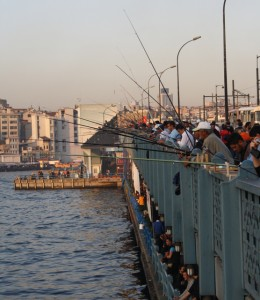
January 29, 2012 画像103
Photo by Joy E. Stocke
(Editor’s Note: Istanbul was chosen as the European Capital of Culture for 2010. The Galata Bridge separates the European Side iof istanbul from the Asian or Anatolian side.)
There you are and there it is: Sunset fast approaching.
You are outside Istanbul’s Egyptian Spice Bazaar, part of a crowd of people rearranging packages of Antep pepper, cumin, coffee; sipping glasses of tea, talking on cell phones as you pass through a swirl of more than a hundred pigeons who fight greedily for scraps of bread.
In front of you, Eminönü Station where the ferries line up and bellow a deep collective moan. Rust-covered chains lower gangplanks for the rush hour crowd heading up the Bosphorus past the Sea of Marmara to Üsküdar, Hydarpasa and Kadikoy on the Asian side.
Ahead, your destination, the Galata Bridge, the so-called Milky Way that spans the base of the Golden Horn from Eminonu to the suburb of Galata. Galaktos means milk in Greek and the word Bosphorus means cow ford, and you are about to watch the sun set aflame the estuary known as the cow’s Golden Horn.
The name Istanbul is also said to come from the Greek, “eis tin Polis”; simply, “to the City.” A city of hills surrounded by water intermingling in the Bosphorus Channel – the heavy saline Sea of Marmara, son of the Aegean; and the less salty Black Sea, daughter of the Caucasus.
Below the Golden Horn, at the confluence of the Bosphorus and the Sea of Marmara, construction is underway to build the world’s deepest underwater tunnel. There, engineers discovered a gravesite that pushes the city’s first inhabitants back to the 7th millennium when agriculture spread from Anatolia – as Turkey is also called – to the Balkans. The excavation has uncovered pottery fragments, shells, horse skulls, and human remains in fetal positions, poised for rebirth.
And the Golden Horn spanned by the Galata Bridge whose metal steps you are now climbing, gives definition to a city that seems to float on water. Formed by the sweet water of two underground springs flowing toward the Sea of Marmara, the Golden Horn has protected ships for the Byzantines, Venetians, Genoese, Ottomans; an estuary rich enough to provide nutrients for many species of fish including gray mullet sold in the markets along the its banks.
Water flowing in currents, people flowing in currents, boys selling rings of sesame-topped bread called simits. Along the bridge’s railed expanse, vendors grill mussels and chewy corn on the cob. Girls in peg-leg jeans, some in headscarves, and boys in black T-shirts flirt and tease and tap at the keyboards of their cell phones. Men, young and old in caps with their buckets of bait rest fishing poles against the railing and wait.
Flash of gold, flush of honey over the suburbs that fan out from the Golden Horn in a maze of streets and brick and stone and mortar: Fener, Balat, Galata.
Cries of sea gulls, rocking of pleasure boats, a reddening as if the horn is lit from within. You look up when the muezzin’s call to prayer rises from the minaret of the Süleymaniye Mosque, tinny, distorted, la il’allalh ilallalh – there is no god, but god.
The sun drops, flamingo-red, burning through the atmosphere. Fire meets water and the whole lot of you – commuters, sightseers, fishermen, lovers – breathe in the golden air, breathe in the scent of diesel, brine, muck, fruit blossoms, yeast.
A ferry pulls away from the dock and you think about a Phoenician maiden called Europe who fell in love with a bull; how, on his back he carried her and her culture across the water from Asia Minor to the continent that would bear her name.
There you are. And there it is: Impossible to grasp.
Darkness gathers and with your heart full of wonder you cross the bridge to Galata to a taverna where a beloved friend waits in candlelight at a table on the crescent edge of the Golden Horn.
To support our mission and passion for good storytelling, please make a tax-deductible donation by clicking here: Wild River Donation.
Comments Off
January 17, 2011
Listening to Schumann’s Piano Concerto
Filed under: WRR@LARGE — Tags: Dzvinia Orlofsky, Piano, poetry, Schumann, Wild River Review, wildriverreview.com, WRR@Large — joystocke @ 4:05 pm
Listening to Schuman’s Piano Concerto
by Dzvinia Orlofsky
That we don’t all die in childhood
is the greater miracle.
God lifting His light hand
to bring out a phrase, clearing the pedal.
We wear our jewels for the afternoon,
startle birds with the immensity
of our human shadows.
We’ve made it to hard chairs.
Restlessly our hands roll program notes
into telescopes; we intercept genius
with our signature cough.
But what is to be known of great music
other than it requires black polished shoes
and silence,
the incontestable desire to sleep?
See how our mouths relax into soft wax,
our faces drip down our throats.
This is what it must feel like to be lovingly held.
Hear how beauty begs forgiveness
for not including us.
DZVINIA ORLOWSKY is a founding editor of Four Way Book and the author of three poetry collections including “Except for One Obscene Brushstroke” (Carnegie Mellon University Press, 2004). Her poetry and translations have appeared in numerous anthologies including “A Map of Hope: An International Literary Anthology; From Three Worlds: New Writing from the Ukraine”; and “A Hundred Years of Youth: A Bilingual Anthology” of 20th Century Ukrainian Poetry. She currently teaches at the Solstice Low-Residency MFA in Creative Writing Program at Pine Manor College.
To support our mission and passion for good storytelling, please make a tax-deductible donation by clicking here: Wild River Donation.
Comments Off
March 18, 2011
A Letter To Family and Friends From Sendai
Filed under: WRR@LARGE — Tags: earthquake, hope, Japan, letter, Sendai, tsunami — joystocke @ 3:32 pm

January 29, 2012 画像104
Hello My Lovely Family and Friends,
First I want to thank you so very much for your concern for me. I am very touched. I also wish to apologize for a generic message to you all. But it seems the best way at the moment to get my message to you.
Things here in Sendai have been rather surreal. But I am very blessed to have wonderful friends who are helping me a lot. Since my shack is even more worthy of that name, I am now staying at a friend’s home. We share
supplies like water, food and a kerosene heater. We sleep lined up in one room, eat by candlelight, share stories. It is warm, friendly, and beautiful.
During the day we help each other clean up the mess in our homes. People sit in their cars, looking at news on their navigation screens, or line up to get drinking water when a source is open. If someone has water running in their home, they put out sign so people can come to fill up their jugs and buckets.
Utterly amazingly where I am there has been no looting, no pushing in lines. People leave their front door open, as it is safer when an earthquake strikes. People keep saying, “Oh, this is how it used to be in the old days when everyone helped one another.”
Quakes keep coming. Last night they struck about every 15 minutes. Sirens are constant and helicopters pass overhead often.
We got water for a few hours in our homes last night, and now it is for half a day. Electricity came on this afternoon. Gas has not yet come on.
But all of this is by area. Some people have these things, others do not. No one has washed for several days. We feel grubby, but there are so much more important concerns than that for us now. I love this peeling away of
non-essentials. Living fully on the level of instinct, of intuition, of caring, of what is needed for survival, not just of me, but of the entire group.
There are strange parallel universes happening. Houses a mess in some places, yet then a house with futons or laundry out drying in the sun.
People lining up for water and food, and yet a few people out walking their dogs. All happening at the same time.
Other unexpected touches of beauty are first, the silence at night. No cars. No one out on the streets. And the heavens at night are scattered with stars. I usually can see about two, but now the whole sky is filled.
The mountains of Sendai are solid and with the crisp air we can see them silhouetted against the sky magnificently.
And the Japanese themselves are so wonderful. I come back to my shack to check on it each day, now to send this e-mail since the electricity is on, and I find food and water left in my entranceway. I have no idea from whom, but it is there. Old men in green hats go from door to door checking to see if everyone is OK. People talk to complete strangers asking if they need help. I see no signs of fear. Resignation, yes, but fear or panic, no.
They tell us we can expect aftershocks, and even other major quakes, for another month or more. And we are getting constant tremors, rolls, shaking, rumbling. I am blessed in that I live in a part of Sendai that is a bit elevated, a bit more solid than other parts. So, so far this area is better off than others. Last night my friend’s husband came in from the country, bringing food and water. Blessed again.
Somehow at this time I realize from direct experience that there is indeed an enormous Cosmic evolutionary step that is occurring all over the world right at this moment. And somehow as I experience the events happening now in Japan, I can feel my heart opening very wide. My brother asked me if I felt so small because of all that is happening. I don’t. Rather, I feel as part of something happening that much larger than myself. This wave of birthing (worldwide) is hard, and yet magnificent.
Thank you again for your care and Love of me,
With Love in return, to you all,
Annon.
*This letter was forwarded to us by a friend. The original sender is unnamed.
Comments Off
April 29, 2011
Sending Joan Didion a Friend Request
Filed under: WRR@LARGE — Tags: Facebook, Gerri George, Joan Didion, wildriverreview.com — joystocke @ 8:28 am
Sending Joan Didion a Friend Request
January 29, 2012 画像105
by Gerri George
So, you’re looking at the number of friends you have on Facebook and it’s, well, pretty scant. Some of those in your circle have, like, a thousand friends and you’re feeling pretty down about it and you think you’ll add to your list and so you decide to see if Joan Didion has a Facebook account.
You back up for a minute and think about this.
You remember how you sent one of your favorite comedians a friend request and it’s still pending and you figure he doesn’t want to be your friend, he doesn’t even know you, but you like him and you want him to like you and its painful not hearing back. But for some reason you’re thinking that Joan Didion will accept you as a friend. You have things in common, after all. You’re both literary writers and you love her work and you’re certain if she could read yours, she’d return the love.
In addition to the content of her books, you’ve grown to admire two vintage photos of her with a cigarette in her hand, and she looks mythic and fabulous and you wonder if she still smokes, and if she does, you’d like to be able to tell her the method whereby you quit smoking shortly after graduating from University of Penn. And if she has quit smoking, that’s another thing you have in common.
You watched her accept the National Book Award for The Year of Magical Thinking and you knew it to be a fine, deserving book because you read it and loved its brilliance and felt the sadness.
You’d love to have a chat with her in New York over strong coffee in one of those tony downtown cafes as a prelude to friending her on Facebook.
“Joan,” you’d say, as you relished the sound of her spoon stirring half-and-half into a mug of house brand, “I’m speechless at your talent. To what do you owe your success?” She’s savvy and sophisticated and she’d probably respond with “Good genes and hard work, my dear writer friend. That’s the secret of my success.”
You’d want to tell her that editors and publishers won’t know that you, personally, might already have good genes and hard-working habits until that time when you happen to hit it out of the park, but you decide you’ll keep such thoughts to yourself. You wouldn’t want to discourage her wisdom. She’s Joan Didion, after all.
Coffee in New York with Joan might be your best chance of having her accept your friend request, but you’re pretty sure coffee isn’t in the cards, so, you access your Facebook account and you key in Joan Didion’s name and there are multiple Joan Didions, and then there’s one with her picture, a dramatic black and white photograph and she looks remarkable with light hair and sharp features and that cast-iron expression confirming she has nothing to prove, but you can’t add her as a friend or even send her a message.
It seems there’s a conspicuous blank space in the data field where the options to receive a friend request would ordinarily reside. Blank space…thwarted…no chance for kinship.
Joan Didion needs no new friends. She is in possession of everything the fates have allowed.
You’re disappointed.
Hmmm. Maybe Cormac McCarthy or Michael Ondaatje has a Facebook account.
Gerri George’s stories, which often portray the human side of outsiders, have appeared, or are forthcoming, in Literal Latte, Penn Review Literary Magazine, The Bucks County Writer, Quiddity International Literary Journal, Wild River Review, Front Range Review, and elsewhere. “A Rose by Any Other Name” was a Pushcart Prize nominee. “Night,” read by a professional actor before a literature-loving audience in London, Soho (OK, so it was a pub), also appears in audio and text on the Liars’ League website, under the Sex and the City theme. I received a Barbara Deming Memorial Fund writing grant for women artists. Hastings, America – a poem (America Ground, Hastings) – read at the Hastings Festival in England on July 4, 2010, and will be published in their anthology. The Great Idea Drought appeared in The Penn Writer, and I won a Writer’s Digest contest in the category of TV/Movie Script. Twitter.com/gerrigeorge facebook/Gerri George
To read George’s short story “Henry Moore and the Bookstore Clerk”, click here: Henry Moore.
Comments Off
| © 2009 Wild River Review | ISSN: 1932-362X | Terms of Use | Sign Up for Our Mailing List |